
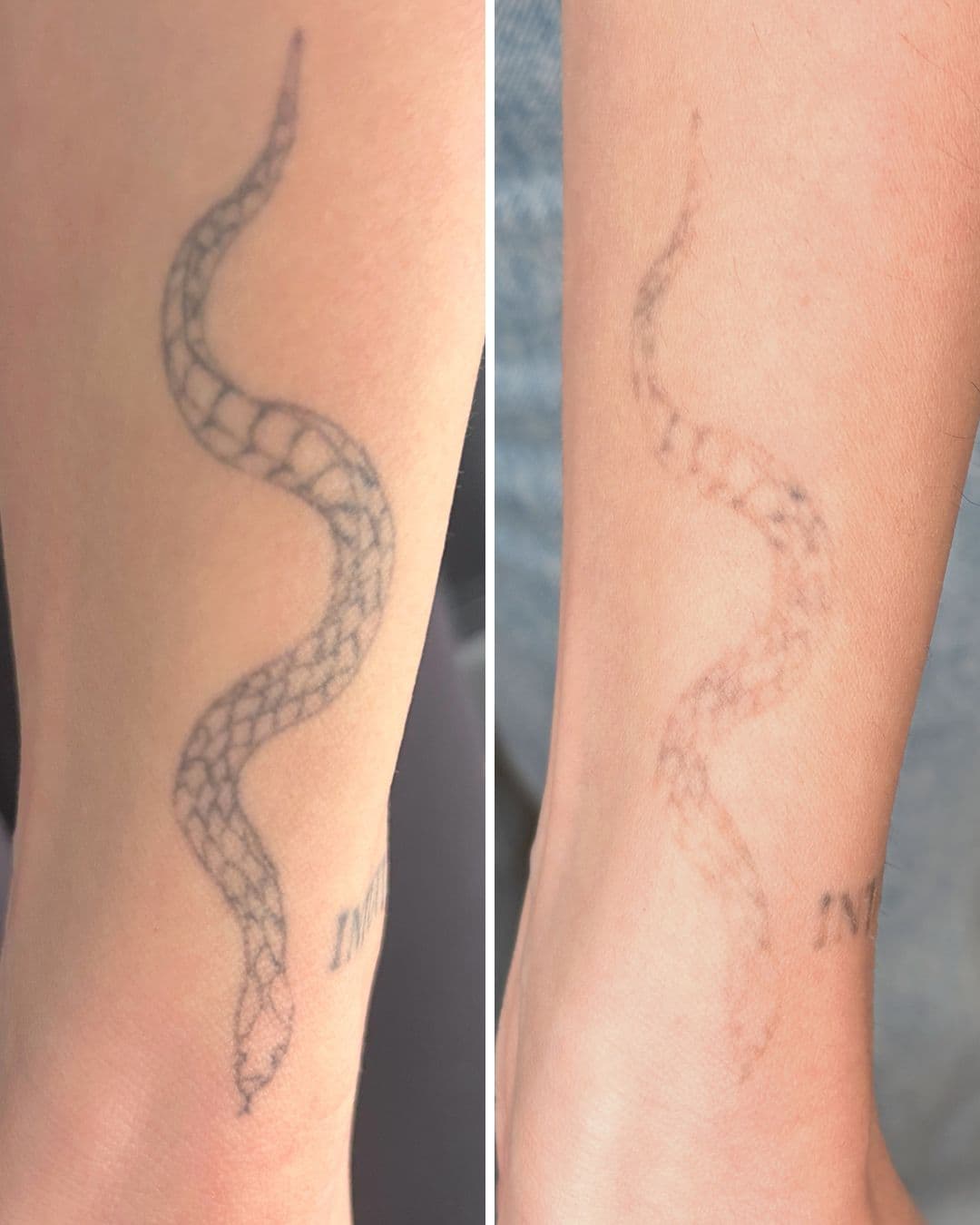
The before is a clear, black snake tattoo running down a forearm. The after, taken two sessions later, shows that same snake barely visible, most of the pigment already gone. For anyone who has been quoted 9 to 12 sessions to remove their tattoo, a result like that raises an obvious question: why did this one clear so fast?
The answer comes down to two things: how much pigment was placed in the skin, and how deeply it was placed. Those two factors, saturation and depth, do more than anything else to predict how quickly the body can clear a tattoo after each session.
How much pigment was placed
A heavily saturated tattoo, the kind built from dense solid fill and multiple passes of colour, contains far more pigment than a lightly shaded outline. The laser can shatter that pigment in a session, but the body can only process so much at once. The lymphatic system clears a portion between appointments, and the rest waits for the next treatment.
A lightly saturated tattoo, such as an outline piece or a design with thin shading and minimal fill, has much less total pigment to begin with. The body has less to clear after each session, and visible fading arrives faster. The difference is not in the laser settings or the session length. It is in the total volume of work left for the body to do.
This is why Studio Kiku quotes the 9 to 12 session range specifically for dark, saturated work on laser tattoo removal consultations. That number reflects the typical heavily packed tattoo. An outline piece, a fine-line design, or a tattoo built with light shading sits in a different category and can often resolve in 3 to 6 sessions rather than 9 to 12.
How deep the pigment was placed
Most tattoos are placed in the dermis, but the exact depth varies with artist technique and style. Fine-line and outline-style work tends to be placed more superficially than heavy traditional fill. Pigment closer to the surface of the skin is more accessible to the lymphatic system, which means the body can reach and begin clearing it more efficiently after each session.
Deeply placed pigment takes longer to surface and longer to clear. That is part of why solid, heavily worked traditional tattoos consistently sit at the higher end of session estimates, even when the colour is a relatively responsive black or grey. The volume is there, and so is the depth.
What your body does between sessions
The laser session itself is fast. A full pass takes minutes. The real removal happens in the weeks that follow, as the body gradually processes the shattered pigment particles through the lymphatic system. "The laser is very fast at breaking the pigment," says Billy DeCola, Studio Kiku founder. "The thing we're waiting on is your body."
Where the tattoo sits on your body matters too. Areas with stronger circulation, such as the torso and upper body, clear pigment faster than the extremities. Fingers, feet, and ankles are among the slowest-responding sites, regardless of how lightly saturated the pigment is.
Overall health affects the pace as well. A well-rested, well-hydrated body clears shattered pigment faster than one that is run down. The laser tattoo removal aftercare guide covers what to do between sessions to support the clearing process.
Why the surface can mislead
Saturation and depth are not always easy to read from the outside. A tattoo that looks lightly shaded on the surface may have been built up in multiple passes, with more pigment underneath than is obvious at a glance. What appears to be a simple outline can carry a heavier load than expected if the artist worked slowly with dense application.
The only reliable way to estimate a realistic session count is an in-person assessment. The team at Studio Kiku looks at the tattoo, checks for scar tissue, evaluates the saturation and colour mix, and considers the placement before giving you a range.
There are also tattoos that will not fully clear regardless of how lightly they were placed. Pigment containing white, light blue, or certain opaque colours may not respond completely to laser energy. The team will be direct about that before any sessions are purchased. For clients with heavily saturated work, the Complete Removal Package covers as many sessions as it takes at a single flat rate, which removes the uncertainty around final cost.
If you are wondering where your tattoo falls on the spectrum, that's a five-minute question at a free consultation. Saturation, depth, and pigment quality can all be judged once a technician sees the actual piece. Book a free consultation at Studio Kiku in Vancouver, Langley, or Vaughan.
Thanks for reading.