
The PicoWay
Every laser treatment at Studio Kiku runs on one platform: the PicoWay by Candela.
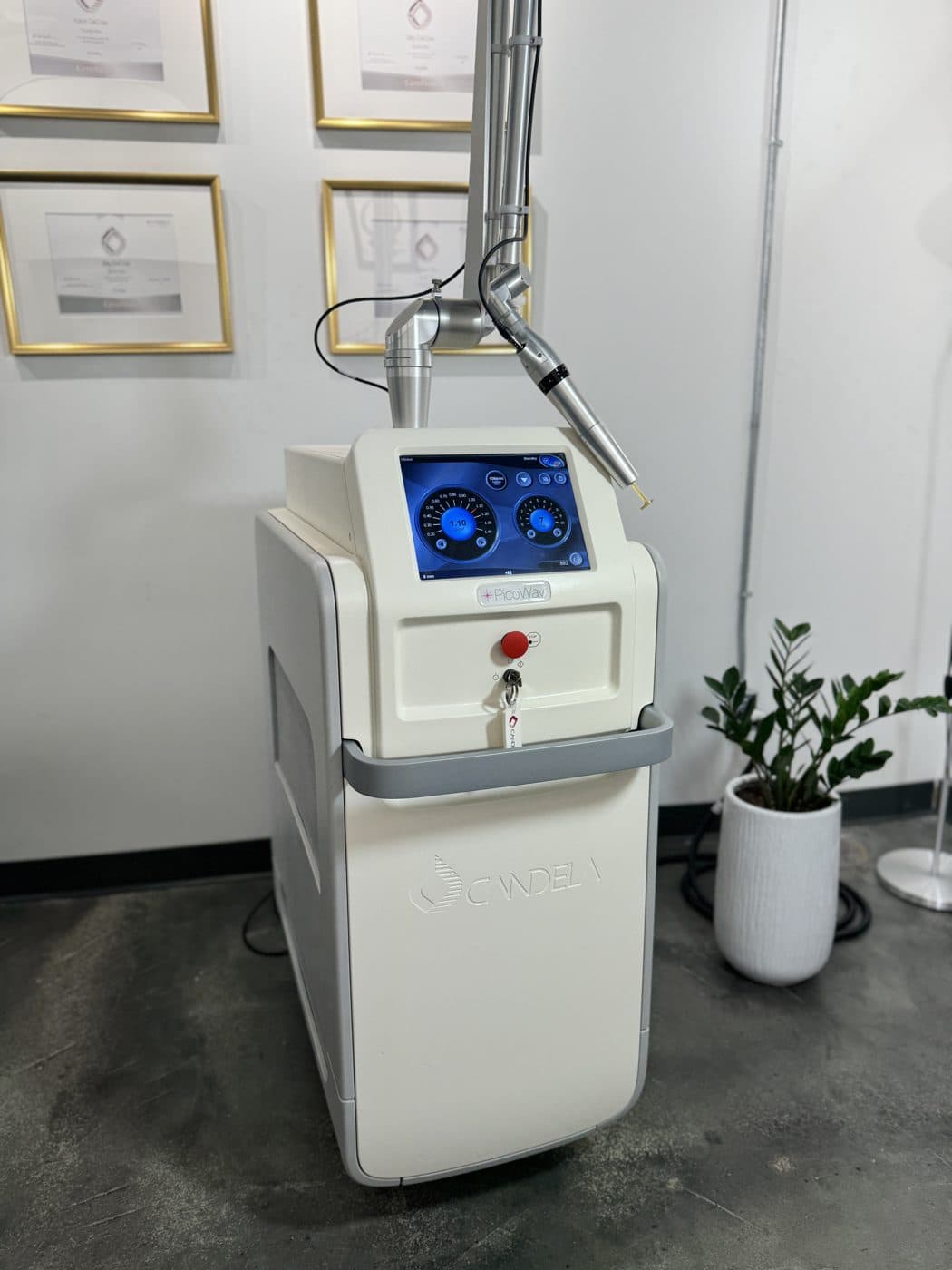
The Machine
The PicoWay is Candela Medical's picosecond platform. It fires pulses measured in trillionths of a second across three wavelengths, which is what lets one machine handle tattoo pigment, permanent makeup, and scalp micropigmentation without compromising on any of them.
Studio Kiku runs the same platform and the same protocols at every studio, so the treatment you get does not change with the address. Billy DeCola is recognized as a Key Opinion Leader by Candela Medical, and Studio Kiku trains other technicians on this machine.
Pico Is a Category. PicoWay Is a Machine
Pico is short for picosecond, which is a unit of time. One picosecond is a trillionth of a second. That is all the word means. It describes how briefly a pulse lasts, and nothing else.
So “pico laser” is a category, roughly the way “SUV” is a category. It covers a very wide range of machines at very different levels, and on its own it does not tell you which wavelengths a device carries, how much peak power it actually delivers, or whether every wavelength on it is genuinely operating in the picosecond domain rather than being marketed alongside ones that are not.
That gap is worth knowing about as a client, because a studio can advertise “pico” truthfully while running something quite different from what you pictured. The word has become a promise in the industry, and it was never specific enough to carry one.
When Studio Kiku says pico, it means the PicoWay by Candela. That is the machine in the room, at every location, for every treatment.
Shorter Pulses, Less Heat
Older lasers work in nanoseconds. A nanosecond pulse is around a thousand times longer than a picosecond one, and over that extra time a lot of the delivered energy turns into heat in the tissue around the target. Heat is what drives most of the risk in laser work: blistering, pigment change, and scarring.
A picosecond pulse is too brief for that heat to spread. The energy arrives faster than the tissue can conduct it away, so the dominant effect becomes mechanical, a rapid pressure change that shatters pigment rather than cooking it. The particles come apart smaller, and smaller particles are easier for your immune system to carry off.
That is the whole advantage, and it is a real one: better clearance per session, and less thermal stress on the skin getting there. It is not magic, and it does not remove a tattoo in one visit. Most tattoos still take several sessions spaced at least eight weeks apart, because the clearing is done by your body between appointments, not by the laser during them.
Different Colours Absorb Different Wavelengths
- 1064 nm
Blacks, browns, and darker pigment
The workhorse, and the safest option when working on melanin rich skin tones.
- 730 nm
Blues and greens
The colours that other lasers struggle with most. Blues and greens sit in a narrow absorption window.
- 532 nm
Reds, oranges, and yellows
The sunset colours of the spectrum, including the warm undertones that permanent makeup pigments are usually built on.
One Machine, Several Tools
The wavelength determines which pigment is targeted. The handpiece determines how the energy pulse is delivered, as one full beam or as a grid of micro-beams. Swapping handpieces allows us to treat various tattoos.
Zoom
532 nm / 1064 nm
The full-beam handpiece, with a spot size that adjusts from 2 mm up to 10 mm. It carries most of the tattoo and pigment work, small and tight for detail, wide and open for large pieces.
730
730 nm
A dedicated full-beam handpiece for blues and greens. The platform also offers a 785 for the same colour family; Studio Kiku runs the 730 across its studios.
Resolve
532 nm and 1064 nm
Instead of one beam, Resolve splits the energy into a grid of micro-beams inside a 6 x 6 mm spot. That creates zones of activity under the surface while leaving the skin between them untouched, which is what keeps the downtime low.
Resolve Fusion
532 nm
The micro-beam grid with a diffuse ring around it, so a single pass treats at two depths at once.
What We Treat with It
Tattoos
Complete removal, partial removal or fading for a cover-up. Effective treatments while maintaining the integrity of the skin.
Tattoo removal →Permanent Makeup
Microblading, powder ombre, nano strokes, combo brows, lip blush, and tattooed freckles. Safe and effective treatments that will not damage hair follicles or existing hair.
PMU removal →What the Platform Gives Us
High Peak Power
Energy delivered in a picosecond pulse rather than spread over a longer one, so the effect on pigment is mechanical rather than mostly thermal.
Three Wavelengths
One machine covering blacks and browns, blues and greens, and reds through yellows, instead of a single wavelength doing everything badly.
Every Skin Tone
Cleared for Fitzpatrick I through VI in tattoo removal, with the 1064 nm wavelength carrying the work on deeper skin tones.
Low Downtime
Most sessions run 15 to 20 minutes, and most people are back to normal activity within a day or two.
Safe on Every Skin Tone, When It Is Run Properly
The PicoWay is cleared for tattoo removal across Fitzpatrick skin types I through VI. The reason it can work safely on deeper skin is the 1064 nm wavelength, which melanin absorbs poorly. The energy passes the melanin in your skin and reaches the pigment underneath instead of heating the surface.
The machine is only half of it. Wavelength selection, conservative settings, and honest spacing between sessions are what actually keep skin safe, and those are judgment calls made by a technician. That is why every client starts with an assessment, and why a test spot is often the right first step.
FAQ
Ask Us Anything About the Laser
Book an appointment. We'll go over your skin, your pigment, and what the machine can realistically do for it.
Book an Appointment4.9 from 350+ Google reviews