
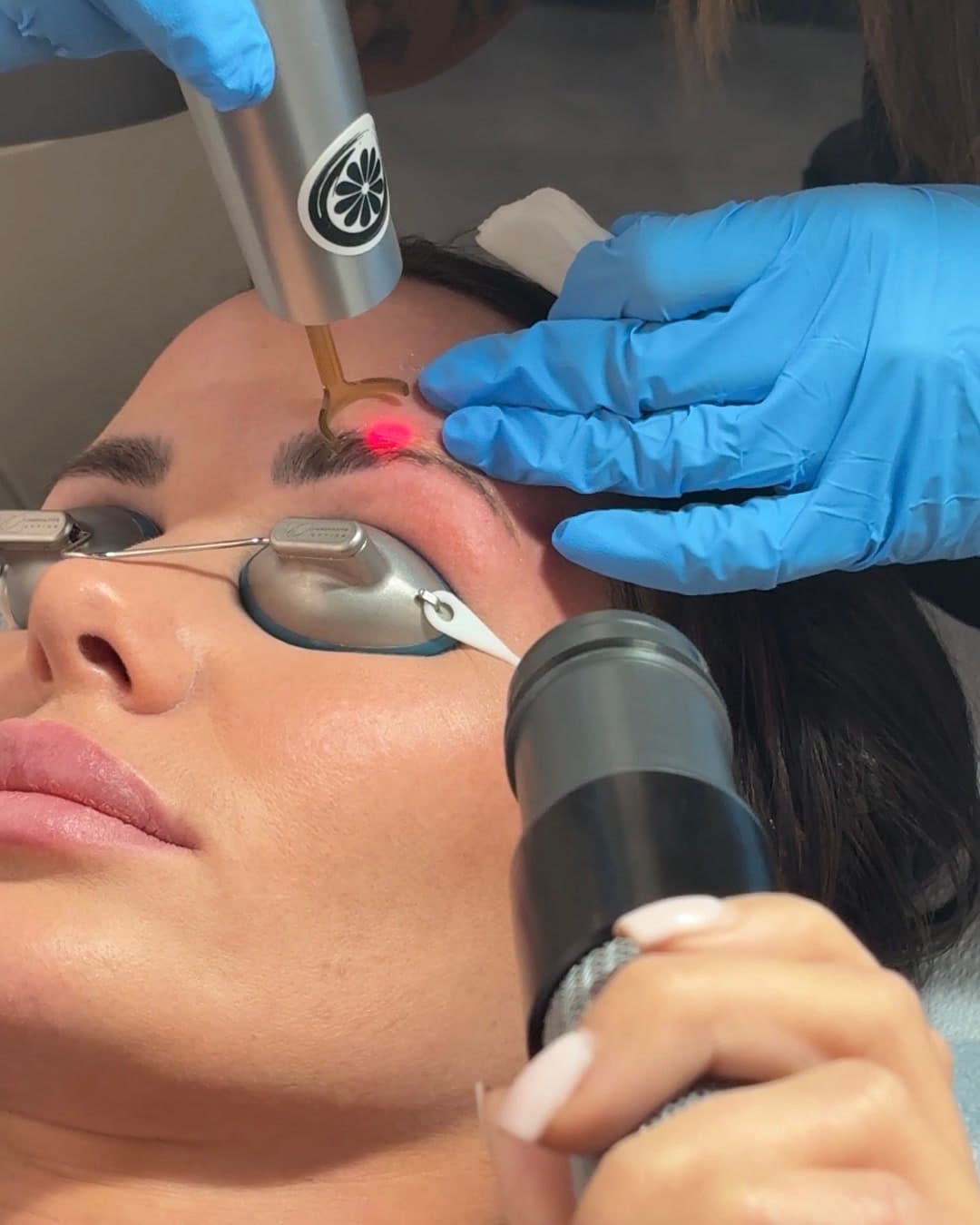
Many clients come to Studio Kiku with the same question: why have my microbladed brows shifted to a reddish, orange, or warm tone? Sometimes the change is gradual, showing up months after the original application. Sometimes it appears suddenly after a laser session. Either way, the reason is the same, and understanding it makes the correction path much clearer.
PMU brow pigment behaves differently from regular body tattoo pigment, and that difference explains nearly every unexpected colour shift clients notice.
How PMU pigment is designed
A black tattoo on the body is almost always straight carbon-based pigment with no additives. PMU brow pigment is different. Pigment manufacturers add warm undertones to the formula, typically reds and yellows, sometimes a combination of both. The reasoning is sound: nobody wants an ashy or bluish-looking eyebrow a year after their appointment. The undertones are there to help brows heal looking natural and warm rather than going flat and cool over time.
The side effect is that the visible shade you leave with after application is not the only colour sitting in the skin. There is always something underneath the outer pigment.
What happens as the pigment ages naturally
Over time, the upper layers of implanted pigment begin to break down. Sun exposure, normal skin turnover, and your body's natural clearing process all contribute. As the top layer fades, the underlying undertone becomes more visible. That is where the reddish or orange cast that concerns so many clients actually comes from. It is not a sign that something went wrong at the time of application. It is the undertone becoming more prominent as the rest of the formula fades around it.
Pigment saturation plays a role too. Brows that were applied heavily, with multiple passes layered in, often shift toward muddy or ashy tones over time. As Billy DeCola, Studio Kiku founder, notes: "They'll mix pigments together thinking, oh, this looks great right here, but they don't really take into consideration how it's gonna heal over time."
Brows applied with a lighter hand tend to show a cleaner warm undertone as they age, rather than a muddied result. The techniques and pigment choices made at the time of application shape what you are dealing with years later.
What the laser does to brow pigment
When PMU brow removal begins, the sequence is predictable. The laser targets the darkest pigment first, because that is what is most visible and what the selected wavelength responds to. The dark layer lifts and fades over the following weeks, but what it leaves behind is the undertone. After the first session or two, many clients see their brows shift to a red, orange, or peach tone. This is a normal progression, not a complication.
From there, the red in the undertone typically responds well to additional laser sessions. Red on its own is one of the more cooperative pigment colours. What can remain after the red is cleared is the yellow, and that is where things get harder. The Faded Podcast episode on brow colour shifts after laser goes through this in detail, and it is worth watching if you are in the middle of the removal process and wondering what you are seeing.
Why yellow is a separate problem
Yellow pigment is genuinely resistant to laser. Studio Kiku sees about a 50/50 success rate with yellow, and no one can predict which side of that line your specific brows will fall on before you start. When yellow cannot be cleared with laser, saline removal is sometimes tried as a backup option. It is worth knowing that saline removal is also not fully effective, and it carries its own limitations.
If the pigment contains white, typically titanium dioxide added to lighten the shade, the situation changes again. When white-mixed pigment is targeted with the laser, the combination can oxidize and actually appear darker rather than lighter. This is why a test spot discussion at your consultation matters. Billy is direct on saline removal as a last resort: "I never, ever recommend saline removal unless the laser is not working on the pigment."
The shifts that can't be undone
Not every colour shift in PMU brows is fully reversible. Red responds well to laser. Orange, which is usually a red-yellow mix, can largely be cleared. Yellow is the genuinely difficult case, and there is no reliable way to predict whether your yellow will respond without trying. If you are hoping to remove your brows completely so you can start over with a different shape, yellow residue that cannot be cleared makes that significantly harder.
If you want to cover existing brows with new work in the same shape, partial fading is usually enough, and yellow remaining is not necessarily a barrier. If shape change is the goal, the expectation needs to be set realistically at consultation, not after several sessions.
The complete removal scenario applies here, and it is not always achievable.
What to do if your brows have shifted colour
The first step is a free consultation. Studio Kiku assesses the pigment, identifies the likely undertone, and maps out the removal process for you, including where the team expects it to be straightforward and where there may be limitations. The studio does not take any money and does not start any treatment until you understand what you are walking into.
If you are ready to take that step, book a free consultation at the Vancouver, Langley, or Vaughan studio.
Thanks for reading.