
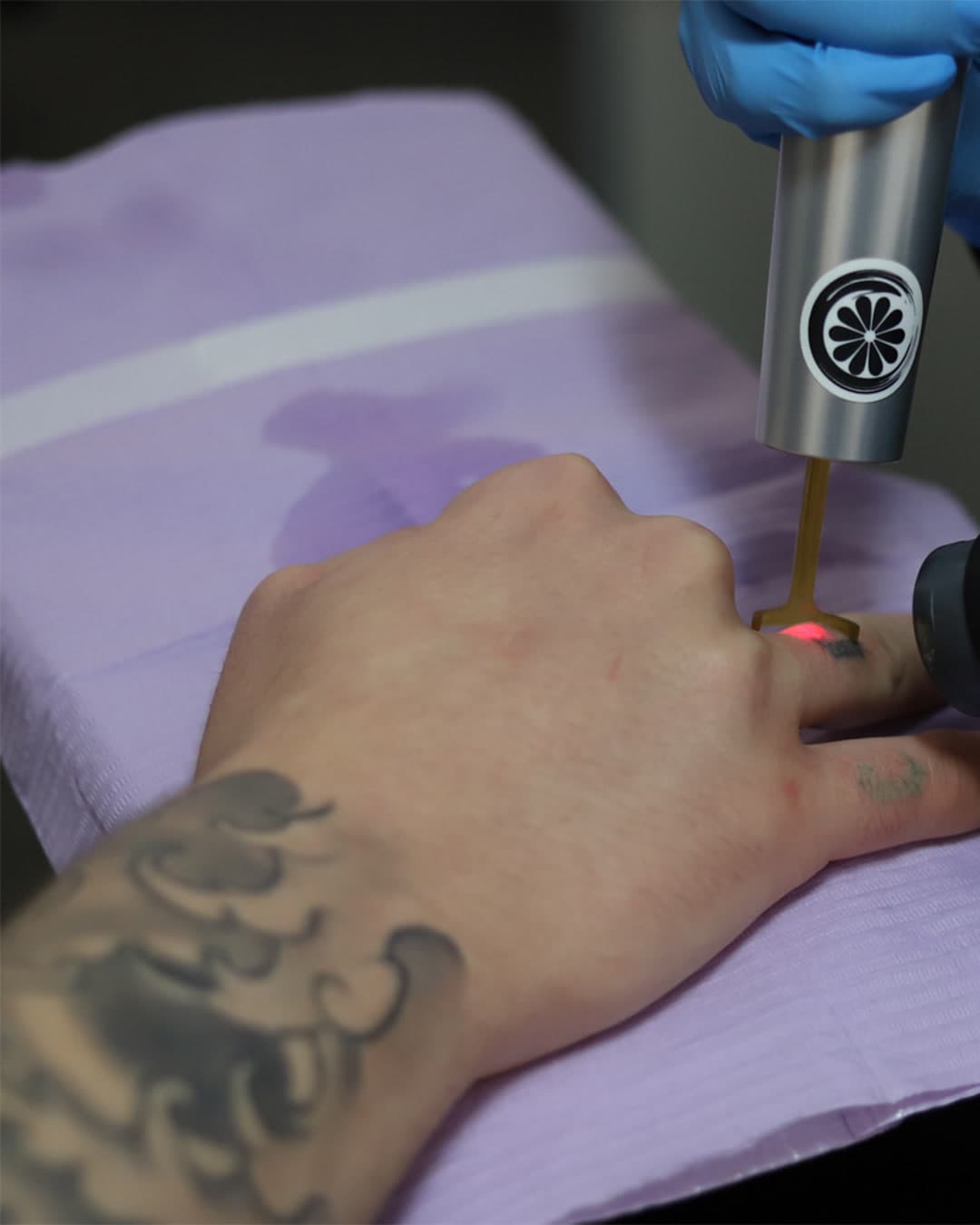
If you've spent time researching tattoo removal, you've likely come across the term "picosecond laser" and wondered whether it actually matters. Studios market the technology heavily, but the reality is more nuanced than the name suggests.
The two main categories of laser used in tattoo removal are nanosecond devices and picosecond devices. You will often see this comparison written as "picosecond vs Q-switched", and that framing is worth correcting before anything else: Q-switching is the technique that lets a laser store energy and release it in one short burst, and both picosecond and nanosecond lasers are built on it. Q-switched is not a category of laser you choose between. Pulse duration is.
That duration is what determines how efficiently the laser shatters pigment and how much stress it places on your skin in the process. The picosecond category also spans a wide range of speed on its own, which matters more than most studios let on.
What "picosecond" actually means
A picosecond is one trillionth of a second. A nanosecond, the measurement used by the older generation of devices, is one billionth of a second. That makes a picosecond pulse a thousand times faster, and that difference in pulse duration has real consequences for how the laser interacts with your skin.
Billy DeCola, the founder of Studio Kiku, explains it like this: "The quicker the pulse, the less damage to your skin. The longer the pulse, the more heat, and the more damage to your skin."
The core idea is straightforward. The faster the laser energy is delivered and gone, the less heat is deposited into the surrounding tissue. Nanosecond devices, while still used at many studios, linger longer on the skin with each pulse.
Why faster pulses are better for your skin
The speed advantage does two things well. Faster pulses shatter pigment particles more efficiently, breaking them into smaller fragments that the lymphatic system can clear more easily. Faster pulses also reduce the amount of heat left in the tissue, which lowers the risk of scarring, hyperpigmentation, and prolonged downtime.
A nanosecond pulse transfers more thermal energy to the skin because it lasts longer. That can cause more redness, blistering, and tissue stress. Those devices are also less suitable for clients with darker skin tones, who face a greater risk of post-inflammatory hyperpigmentation when the treatment isn't calibrated carefully.
Laser tattoo removal done well is about breaking down the pigment efficiently without injuring the surrounding tissue. The technology underneath that goal matters.
Not all picosecond lasers are the same
Pulse durations within the picosecond range vary widely: from around 750 picoseconds (barely faster than an older nanosecond device) down to 300 picoseconds. Some devices sold on discount or grey-market channels claim to be picosecond but operate near 1000 picoseconds, which places them squarely in the nanosecond range.
Billy covered this directly in a recent episode of The Faded Podcast: "Just because the device says Pico on it, that does not mean that it's safe. It does not mean that it's effective, and it definitely doesn't mean that it won't damage your skin."
He uses a helpful analogy to explain why pulse speed matters: it's like grabbing a hot cast iron pan. The faster you grab and let go, the less damage to your hand. The longer you hold on, the more heat transfers. The same principle applies to laser energy on skin.
Well-known branded devices vary from around 450 to 750 picoseconds. The Candela PicoWay, which Studio Kiku uses at every location, operates at 300 to 450 picoseconds: the fastest pulse duration currently available in a clinical device. The PicoWay also delivers energy across multiple wavelengths. Different pigment colours absorb different wavelengths, so having that range available means the device can address a wider variety of colours in one visit.
A faster laser is not a faster body
Faster laser technology doesn't guarantee faster results. A picosecond laser shatters pigment more efficiently than older devices, but your body still has to clear those shattered particles through the lymphatic system, and that process takes time regardless of which laser was used.
Sessions at Studio Kiku are spaced a minimum of 8 weeks apart. That interval exists because the clearing work happens between sessions, not during them. Returning too soon doesn't give your body time to do its part, and it adds unnecessary stress to the skin.
Certain pigments are also difficult or impossible to clear with any laser, including bright yellows, light blues, and pigments containing white. Heavily saturated cover-up tattoos and areas with existing scar tissue are harder cases regardless of the device used. Studio Kiku says so at the consultation, before any treatment begins.
What to ask before you book
Any studio you're considering should be able to tell you which device they use and what its pulse duration is. A clear, specific answer is a better sign than "we use a pico laser" with nothing more. Wavelengths are also worth asking about: a device with only one or two wavelengths may not be able to address every colour in a multi-colour tattoo.
What you do between sessions matters nearly as much as the laser itself. The aftercare guide walks through hydration, sun avoidance, and what to skip in the first 48 hours after a session - all of which have a real effect on how quickly the pigment clears.
What your specific tattoo needs is a question for an in-person assessment, not a spec sheet. The pigment, the depth, the colours, and the condition of the skin together determine what removal will involve, and the consultation reads all four. Book a free consultation at Studio Kiku in Vancouver, Langley, or Vaughan.
Thanks for reading.