
The question most people ask when they walk out of their first session is: why does it look exactly the same? The treated area might be a little red or puffy, but the tattoo is still there. That's not unusual, and it doesn't mean the treatment didn't work.
What happened under the skin is that the laser's energy pulse shattered the pigment into tiny particles. Now your body's lymphatic system takes over, clearing those particles gradually over the weeks and months ahead. The visible fading follows that internal process, which is why how you care for the area after each session makes a real difference to your results.
The first 24 hours
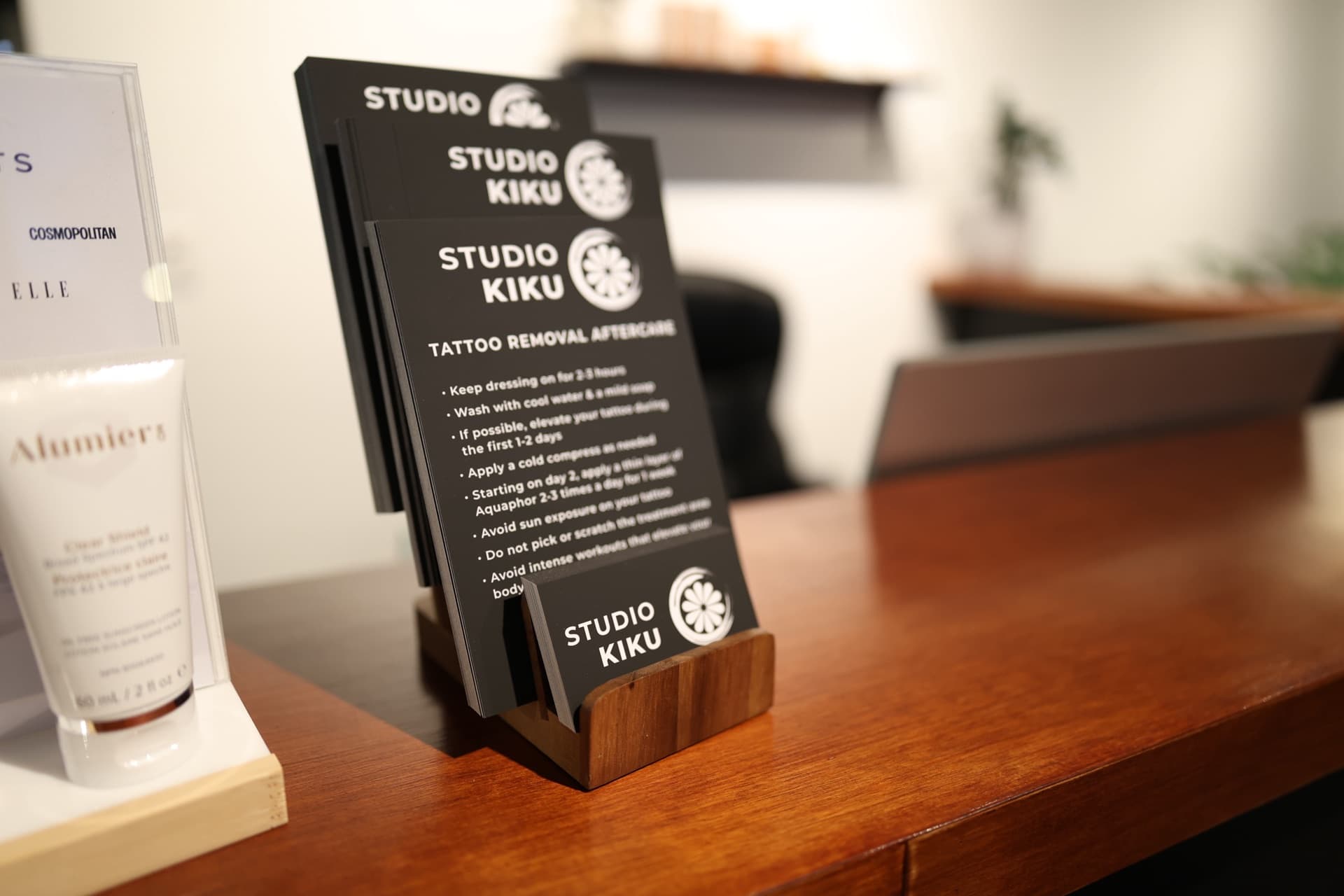
When you leave the studio, the treated area will be bandaged. Leave it on for at least a couple of hours. After removing it, wash gently with a mild soap and cool or lukewarm water, then pat dry with a clean towel.
On day one, skip the ointments and moisturizers. The heat from the session needs to escape through your skin, and sealing it in with Vaseline or similar products can work against that. Leave the skin bare and let it breathe.
Ice is helpful during the first two days. "We always recommend icing the tattoo on the first day and the following day after you get tattoo removal," says Billy DeCola, Studio Kiku founder. Apply a cold compress for about five minutes at a time with breaks in between. One caution: don't over-ice. Applying an ice pack continuously can damage the skin, and those marks look quite different from normal laser side effects.
What to avoid in the first two weeks
For the first couple of days, avoid intense workouts, jacuzzis, saunas, and hot yoga. Anything that raises your body temperature can interfere with your results. After that initial period, you can ease back into activity.
Sun exposure on the treated area should be avoided for at least two weeks. The skin is sensitized after a session, and tanning can increase the risk of complications. If covering the area is difficult, a UV sleeve, KT tape, or a bandage works well. You don't have to avoid the sun entirely, but keep the treatment site protected.
Also skip any active skincare ingredients on the treated area for at least two weeks (retinol, AHAs, BHAs, and vitamin C). The full laser tattoo removal aftercare guide covers this in more detail.
Why you won't see results right away
After session one, the tattoo may look completely unchanged. That's normal. The laser breaks the pigment down, but your lymphatic system clears it slowly, over weeks and sometimes months. Most people don't notice meaningful fading until after two or three sessions.
For a standard dark tattoo (black script, tribal, or traditional), complete removal typically takes nine to 12 sessions in total. As Billy puts it: "On average for a normal, dark tattoo... those types of tattoos take anywhere between nine and 12 sessions to completely remove." Billy covered this expectation gap in depth on The Faded Podcast.
The fading tends to accelerate as sessions accumulate. The first couple of sessions do most of the work of shattering the pigment. The visible clearing often follows later, as your body works steadily through what's been broken down.
What helps between sessions
Your immune system does the heavy lifting between appointments, so looking after your overall health genuinely supports the process. Staying hydrated, eating well, getting enough sleep, and maintaining a regular exercise routine all contribute to better pigment clearance.
When clients ask what they can do to help things along, Billy DeCola's answer is consistent: "Stay hydrated, eat healthy, get rest, exercise, and just be happy, because all of those things are gonna help boost your immune system. And if your immune system is boosted, you're gonna see better results from your laser tattoo removal sessions."
After the first couple of days, you can begin moisturizing the area and return to your regular routine. From that point on, your main role is looking after your health and keeping the area protected from the sun until your next appointment.
Why your tattoo may not follow the script
Not every laser tattoo removal case follows the same path. Heavily saturated tattoos, cover-ups, and certain pigment colours (particularly yellows and whites) tend to take more sessions and may not clear completely. Results also develop unevenly across a single tattoo, since different areas have different pigment depths and saturation levels.
Rushing the process doesn't help. Sessions are spaced a minimum of 8 weeks apart because your body needs that time to clear the previous session's work. Coming in too early is counterproductive. It adds cost without adding results, and it doesn't give your skin enough recovery time between treatments.
If your tattoo is a cover-up, has obvious scar tissue, or has had previous laser treatment elsewhere, raise it at the consultation so the outcome conversation matches your actual skin.
A free consultation is the right first step
If you're considering laser tattoo removal and want to know what your own first session would involve, the team would rather you ask in person than guess from a website. Book a free consultation at Studio Kiku in Vancouver, Langley, or Vaughan and bring every question this post raised.
Thanks for reading.