
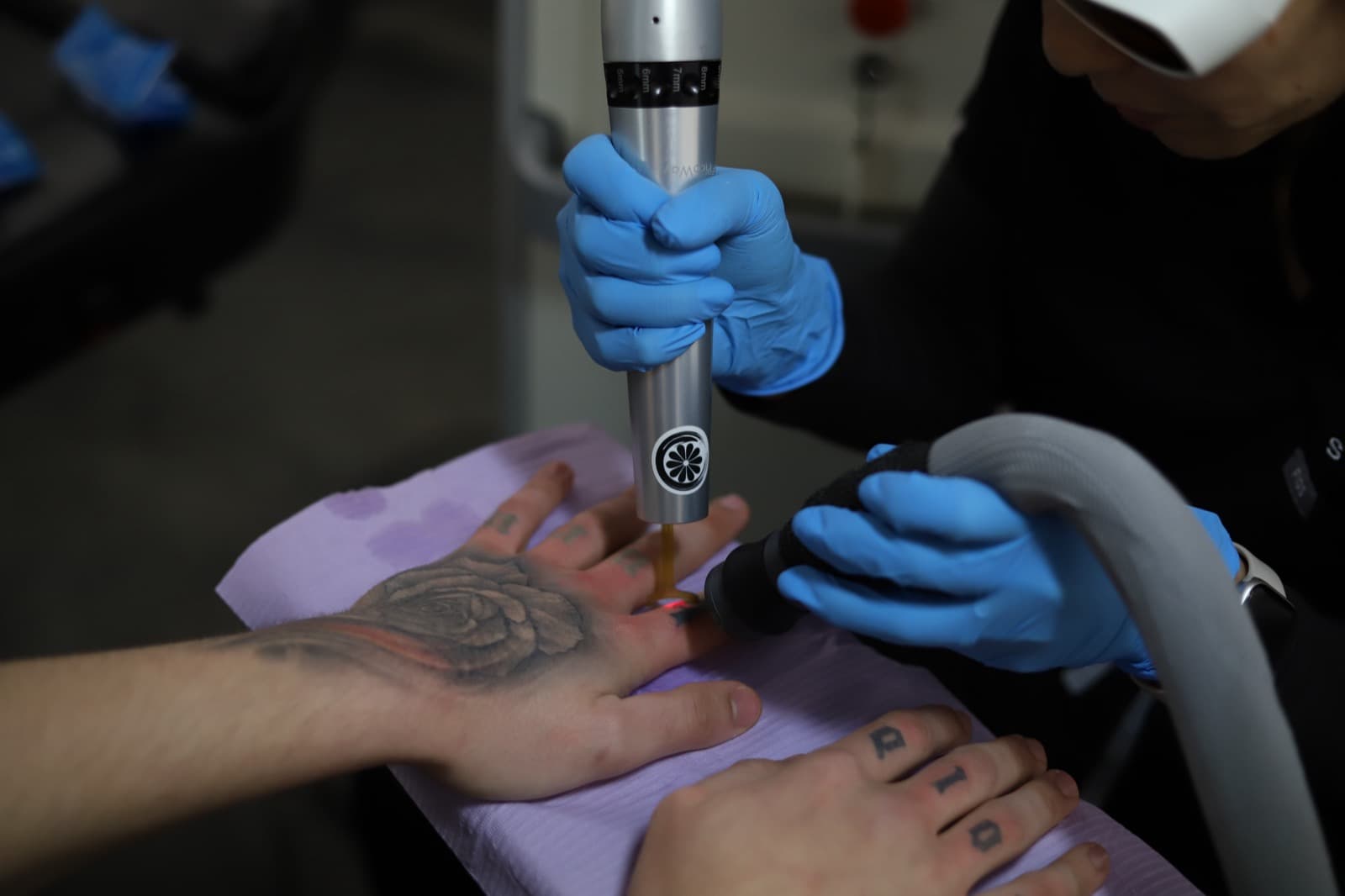
If you're researching laser tattoo removal, one of the first things you'll want to know is how many sessions it'll take. The answer is that it depends on several factors, but there's a framework that helps most people plan realistically.
The number Studio Kiku gives most new clients is 9 to 12 sessions for a dark, saturated tattoo. That estimate assumes standard black-and-grey or traditional work, treated safely and spaced properly. It's not a guarantee, and it won't be the same for every tattoo.
What the laser actually does
The laser doesn't remove pigment from your skin. It shatters it. Each session breaks the pigment particles into smaller fragments, and then your body's lymphatic system clears those particles away over the following weeks.
That second part is the slow part. The laser is fast - a full session takes minutes. But your body takes months to do the clearing work. "The laser is very fast at breaking the pigment," says Billy DeCola, Studio Kiku founder. "The thing we're waiting on is your body."
This is why results don't show up immediately after a session. The fading happens between appointments, not during them.
What determines your session count
No two tattoos respond identically. The main factors that shape your timeline:
- Saturation and depth. A heavily saturated, deeply set tattoo has more pigment for your body to clear. Traditional work and solid black fill typically take more sessions than fine-line or light shading.
- Colour. Black pigment absorbs laser energy well. Bright colours, especially yellows, greens, and pastels, are harder to break down and may require more sessions.
- Location on your body. Areas with strong circulation - your torso and upper body - tend to clear faster than extremities. Fingers, feet, and ankles are among the slowest-responding spots.
- Your health. Your immune and lymphatic systems do the clearing work between sessions. People who are active, well-rested, and well-hydrated tend to see faster fading. This is physiology, not a sales pitch.
- Scar tissue. Some tattoos carry scar tissue from the original application. Where scar tissue is present, pigment can be encapsulated and unable to clear until the tissue itself is addressed.
What a realistic timeline looks like
Sessions are spaced a minimum of 8 weeks apart. The studio often recommends stretching that interval to three or four months, especially once you're several sessions in. "Most people don't realize the body keeps clearing pigment for weeks after the session ends," says Billy DeCola. "Coming in too early just adds pain without adding fade."
Don't be alarmed if you see very little fading after your first or second session. That's normal. The pigment has been shattered but your lymphatic system hasn't had time to clear it yet. Most clients start noticing meaningful fading around sessions three or four.
Billy covered the full session timeline in The Faded Podcast episode on tattoo removal timelines if you want to hear it in his own words.
Why rushing backfires
The biggest mistake people make is wanting to speed things up by treating more aggressively or coming in too frequently.
Turning the laser settings too high early on can clear pigment quickly but damage the skin in the process, leaving scar tissue in the exact shape of the original tattoo. "If you laser it so aggressively, you're going to remove the pigment, but you're going to leave a scar in the same shape of the tattoo that you had," says Billy DeCola. A permanent scar is a harder outcome to live with than a fading tattoo.
The same logic applies to spacing. Returning before your body has finished clearing the broken pigment from the previous session adds discomfort without adding meaningful result. Waiting longer between sessions, especially mid-treatment, is often the most efficient path through the process.
The tattoos that leave a trace
Some tattoos won't fully clear to bare skin. Amateur tattoos with inconsistent depth, tattoos containing certain bright pigments, and tattoos located on areas with poor circulation are most likely to leave a faint trace rather than complete clearance. You'll hear this directly at your consultation, before you spend a dollar.
Studio Kiku also won't treat faster than is safe for your skin. If another clinic has quoted you two or three sessions for a heavily saturated tattoo, the team would encourage you to ask specifically about their treatment settings and what the expected condition of your skin will be at the end. Speed and skin integrity rarely coexist when the approach is aggressive.
The aftercare guide covers exactly how to support your body between sessions - hydration, sun avoidance, and what to avoid in the first 48 hours all have a real effect on how quickly the pigment clears.
The most useful thing you can do right now
Session counts vary enough by tattoo that no answer on a website will be more accurate than a trained technician looking at your specific tattoo in person. The surface area, saturation, colour mix, placement, and condition of the skin all factor in.
If you're ready to put a number on your own timeline, book a free consultation at the Vancouver, Langley, or Vaughan studio. The estimate you leave with will be based on your pigment and your skin, not a chart.
Thanks for reading.