
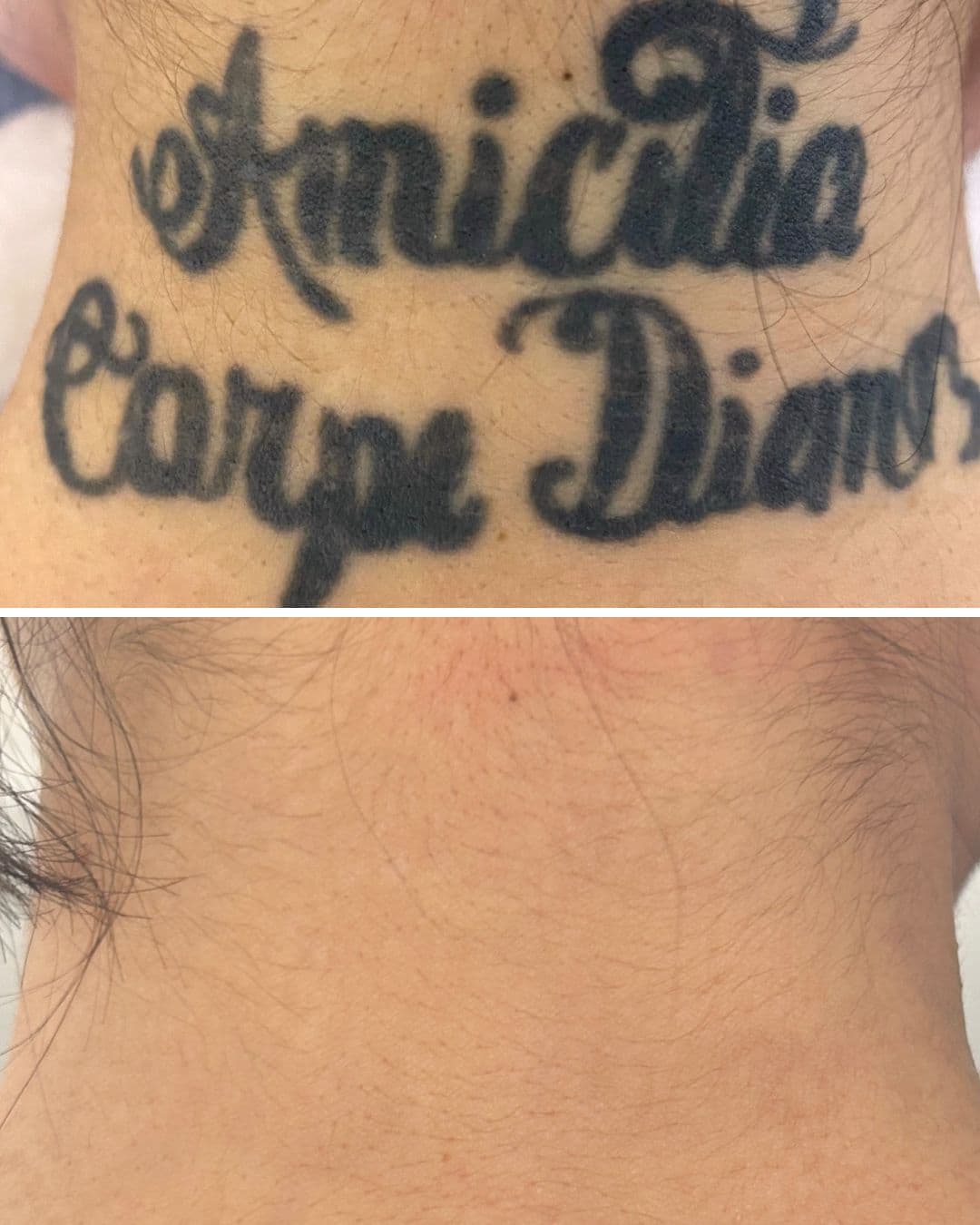
A name across the neck, a couple of words in script, a date in fine lettering: neck tattoos tend to be personal, and they tend to be the ones people most want gone once the meaning changes. The neck is also one of the most visible places on the body to carry old pigment, so there's nowhere to tuck it under a sleeve.
Here's the reassuring part. A dark, well-placed neck tattoo is one of the more straightforward pieces to remove with laser, as long as the work is done at a pace that protects the skin. Studio Kiku removes neck pieces regularly, most of them lettering and script in saturated black pigment.
Why the neck responds well to laser removal
Laser tattoo removal works by sending concentrated light energy into the skin to shatter the pigment into particles small enough for the body to clear over the following weeks and months. Two things speed that up: how healthy and active you are, and how much circulation runs through the treatment area. The neck sits high on the upper body where blood flow is strong, so it tends to clear faster than a tattoo on a finger, foot, or other extremity. Black pigment helps too. It's the pigment that responds most predictably to laser, which is good news for the dark lettering most neck tattoos are made of.
"The laser is fast with breaking down the pigment, but your body is slow with getting rid of that pigment," says Billy DeCola, Studio Kiku founder. The laser does its part in seconds. The timeline is really about how quickly your body carries the fragmented pigment away.
How many sessions a neck tattoo takes
A saturated dark tattoo usually takes somewhere in the range of 9 to 12 sessions to remove completely and safely, with sessions spaced at least 8 weeks apart. That spacing isn't padding. It's the window the body needs to clear the pigment broken up in the previous session before the next one. Across a full removal, that puts most neck pieces on a timeline of roughly a year to two years from start to finish.
Some pieces clear sooner. A lighter or less saturated tattoo can need fewer sessions, and a healthy, active person often sees quicker results than someone whose circulation is sluggish. The consultation is where Studio Kiku puts a number on your specific tattoo, rather than reading one off a chart.
Why going slowly matters more on the neck
It's tempting to want the fastest possible removal, especially for a tattoo you can't cover. The problem is that speed and skin quality pull in opposite directions. Turning the laser up too high too early does remove pigment faster, but it risks leaving a scar in the exact shape of the tattoo, along with possible keloids or changes in skin colour.
Billy puts the trade-off plainly: "Suppose you have a name on your arm or on your neck and you want to get it removed because obviously you don't want that name on your body anymore. But if you laser it so aggressively, you're going to remove the pigment, but you're going to leave a scar in the same shape of the tattoo that you had."
Studio Kiku's approach starts gently. The first sessions break the pigment down at conservative settings to get the body metabolizing it, and the settings only increase as the tattoo fades. It can take longer than a studio that pushes hard from the first visit, but the skin underneath stays intact.
Removing lettering and script
Most neck tattoos are words, and lettering brings its own considerations. Fine script can carry surprisingly dense pigment in the strokes, so each letter needs even, complete clearance for the result to read as clean skin rather than a patchy shadow. Solid black lettering is well suited to that, which is part of why script pieces often finish looking like bare skin, the way the before and after above does.
A cover-up or a piece with existing scar tissue is a different story. Those usually need more sessions, with less certainty about the final result.
Complete clearance is never a promise
Complete removal is never guaranteed. Most saturated black neck tattoos clear very well, but the outcome depends on pigment density, depth, the age of the tattoo, your skin, and your health. Cover-ups, tattoos with scar tissue from the original work, and pieces that have already been lasered elsewhere are harder, and they fall outside the flat-rate package. Some colours, particularly white and light pastels, may not fully clear, though straight black lettering rarely runs into that.
For a full removal at one price, the Complete Removal Package covers a course of treatments instead of charging session by session. Single sessions start at $100.
If there's a name or words on your neck you're ready to move on from, book a free consultation in Vancouver, Langley, or Vaughan. The session count for your piece depends on your skin, your health, and the tattoo itself, and the consultation settles all three before treatment starts.
Thanks for reading.