
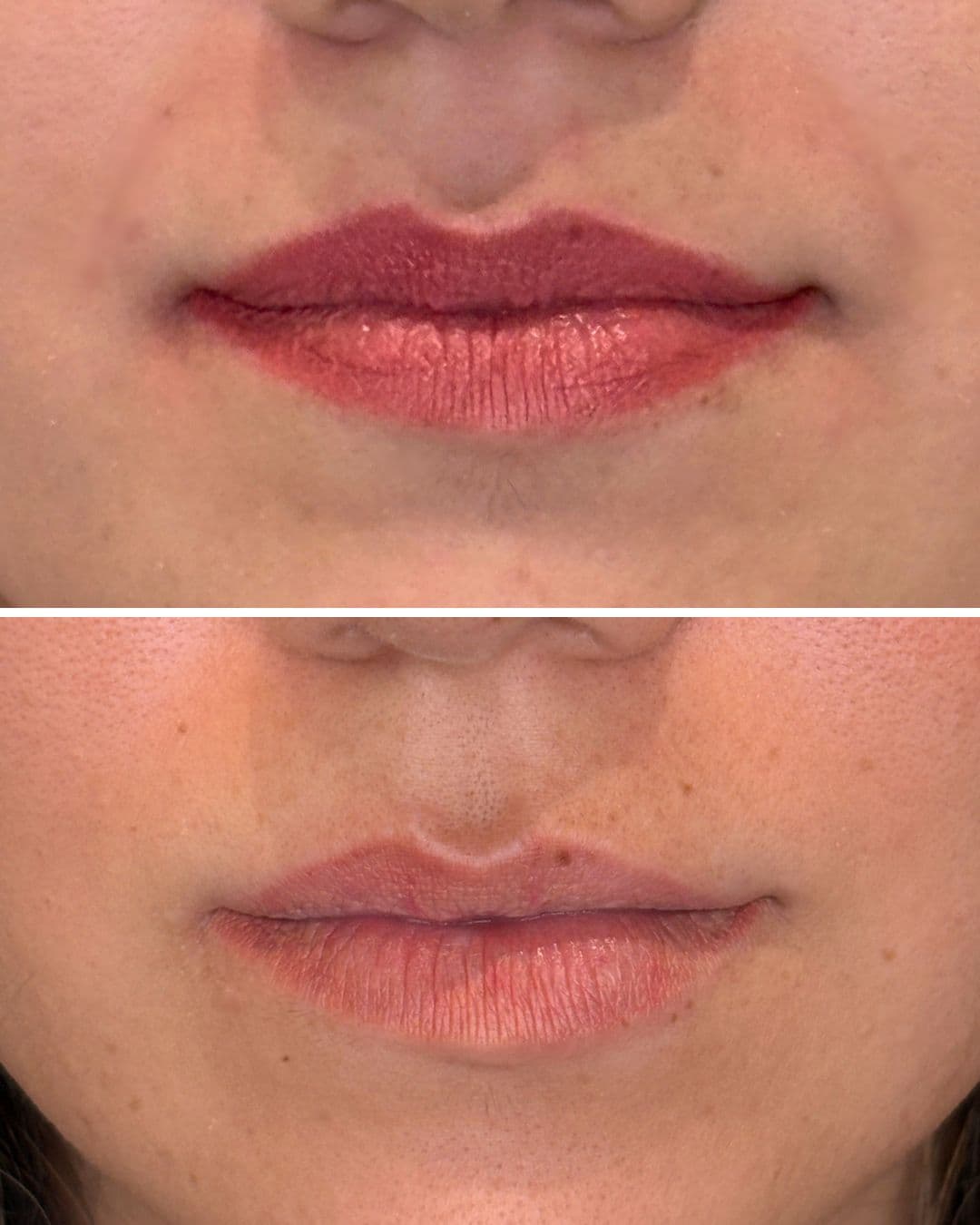
The photo above is a before and after from a single laser session at Studio Kiku. The top panel shows deep, saturated lip blush. The bottom shows lips that have lost almost all of that colour. Results that clear this fast don't happen by accident.
The speed of lip blush removal is largely determined by something most clients only learn at the consultation: what their pigment was made from.
What goes into lip blush pigment
Most lip blush formulas start with a red base to approximate natural lip colour. Artists blend in white to adjust the shade toward lighter pinks, nudes, and flesh tones. A deep berry red contains little white; a soft peachy nude contains a lot of it. That white component creates the visual difference between shades - and it's the factor that most influences how removal goes.
Red pigment responds well to the PicoWay laser. The energy is absorbed, the pigment fragments into particles small enough for the body to clear through the lymphatic system, and fading follows over the weeks after each session. When red is the dominant pigment and saturation is light to moderate, the process tends to be straightforward - and the session count stays low.
How white changes what's possible
White pigment behaves differently under laser energy. When white-containing pigment is hit by the laser, it can oxidize - a colour shift where the pigment darkens rather than lightening. Oxidation can happen immediately after a session or appear days later, and it doesn't always reverse.
This is the variable that separates a two-session removal from a longer, more uncertain one. Studio Kiku founder Billy DeCola and a PMU artist discussed this directly on The Faded Podcast. The PMU artist explained that her own approach is now to use brighter red-based pigments with less white, specifically because those formulas can be cleared by laser without a negative outcome. Her clients accept a shorter-lasting result in exchange for a realistic path to removal if they ever want it.
The tradeoff is real. Pigments formulated for longevity and opacity often contain more white or brightening agents. Pigments chosen with removal in mind contain less. Most clients don't know which category their lip blush falls into until they're sitting in a consultation.
Reading the colour on your lips
The appearance of the lip blush offers some signal about what's in the formula, though it isn't definitive:
- Deep, saturated pinks and berry tones often contain more red and less white, and tend to be better candidates for laser removal.
- Lighter pinks, peachy nudes, and flesh-toned results generally contain more white to achieve that soft, natural look.
- Lip blush that has shifted toward orange, yellow, or a warm tone over time can indicate pigment migration or formula changes, which complicates the outlook.
No surface reading is conclusive. At the Studio Kiku consultation, the team examines the pigment tone directly, asks about the application history and formula if known, and gives a session estimate based on everything together.
What the test spot tells the team
Studio Kiku performs a test spot before any full-pass treatment on lips. The test treats a small section and waits to see how the pigment responds before any broader work begins.
If the pigment fades at the test spot, the session can continue. If the pigment shifts darker, or doesn't move at all, the team can assess the options before committing to a full pass. That information matters before treating the full lip, not after.
The test spot doesn't remove all uncertainty. Lip blush is applied freehand, and saturation can vary across different parts of the lip. A result in one area is useful information, but the pigment depth and density may differ elsewhere along the lip border - a detail the team accounts for when planning each session.
When the formula leaves fewer options
Some lip blush - particularly older applications, heavily saturated work, or formulas with significant white content - doesn't clear cleanly with laser alone.
Studio Kiku has treated clients who arrived after laser removal elsewhere with pigment that had oxidized and turned dark around the lips. As Billy DeCola, Studio Kiku founder, explains: "We've had several clients who have come in who have gone to other laser technicians or other studios to get their lip blush removed and they just have a black ring around their lips."
When oxidation occurs and the pigment stops responding to further laser sessions, saline removal becomes the remaining option. Saline opens the skin and prompts the body to reject the pigment through a different mechanism. It carries its own risks - scabbing, prolonged healing, and a possibility of scarring - and it isn't guaranteed to clear the area.
Not every lip blush can be fully removed. The Studio Kiku consultation is where that conversation happens before anything is booked - covering the formula, the number of applications, and the realistic range of outcomes given what the pigment actually is.
If the kind of result shown in this photo is what you're hoping for, the place to start is understanding what your specific pigment is. A free consultation at Studio Kiku in Vancouver, Langley, or Vaughan covers that assessment in person. For a full overview of what the process involves, the lip blush removal service page has the details.
Book a free consultation and the team will give you a clear picture of what your case looks like before any treatment begins.
Thanks for reading.