
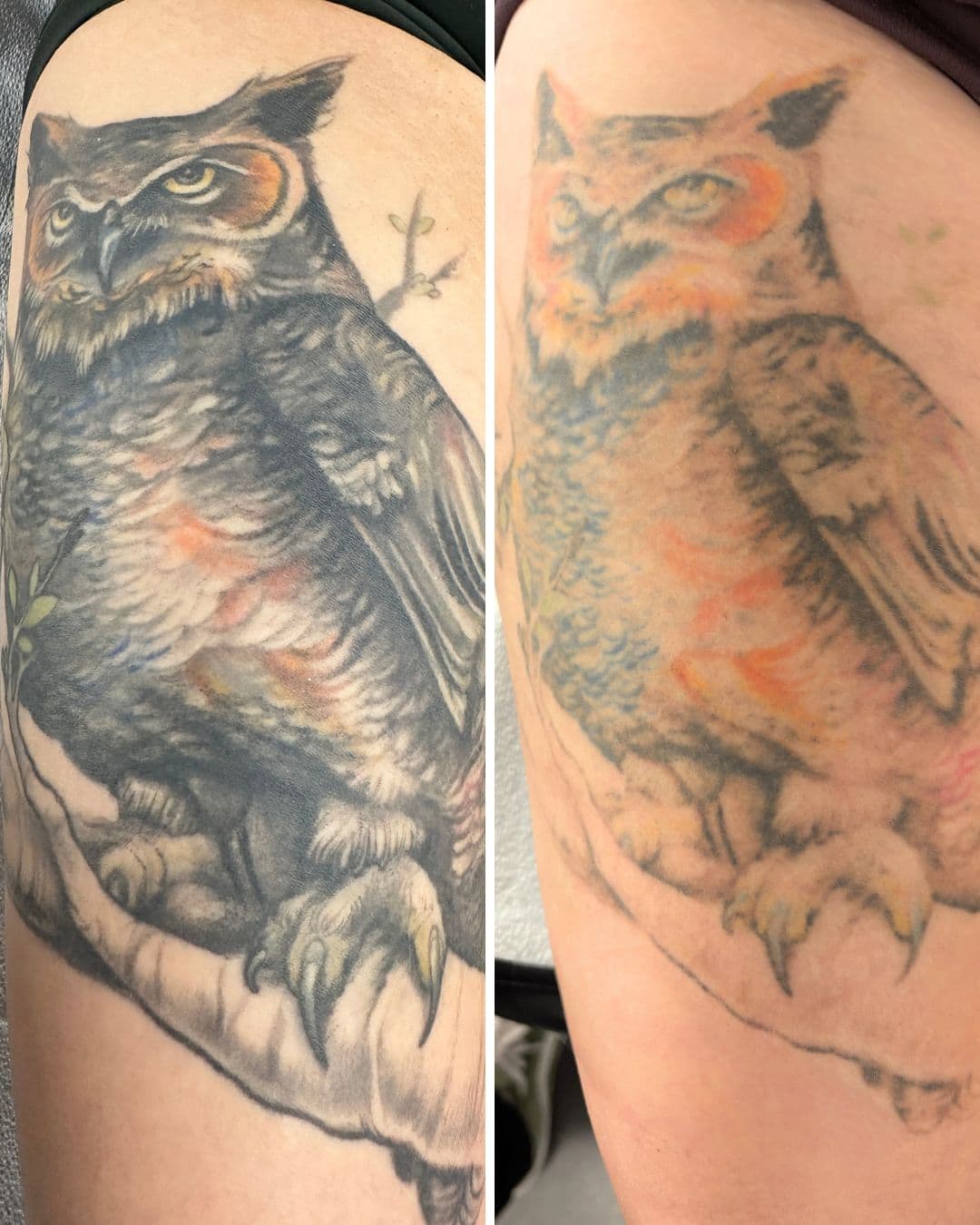
Three sessions into laser tattoo removal, the dark outlines and shadowed areas of this owl are mostly gone. The orange and warm amber in the feathers? Still clearly visible - arguably more so now that the black surrounding them has lifted. For anyone mid-process and staring at a result that looks more uneven than they expected, that's not a sign anything went wrong.
Colour tattoos fade in a sequence, not all at once. The order of that sequence isn't random. It follows directly from the physics of how laser energy interacts with different pigment colours, and understanding it makes the mid-process look a lot less confusing.
Why black absorbs laser energy differently
Laser tattoo removal works by delivering concentrated energy into the pigment, which shatters it into particles small enough for the body's lymphatic system to clear. Different pigment colours absorb or reflect different wavelengths of light, and that relationship governs how quickly each colour responds.
As Billy DeCola, Studio Kiku's founder, puts it: "Most people know that black is the easiest colour to remove, and the reason why it's so easy to remove is because it does not reflect laser. What it does is it absorbs all of the energy. Now, other colours - like blues and reds and yellows - they have a tendency of reflecting certain wavelengths, which doesn't allow them to absorb the energy, and therefore the pigment will not shatter. But black is the easiest colour to remove because it absorbs all of the wavelengths."
The 1064 nm wavelength that the PicoWay uses to target dark pigment is effective across a wide range of skin tones, and black absorbs it readily. In a colour piece with dense black outlines and shadowed areas, those dark elements respond quickly and visibly - which is why, three sessions in, an owl's dark feathers can be barely there while the warm tones underneath remain distinct.
What orange and amber pigments face
Warm-toned pigments - the oranges, reds, and ambers that add dimension to a colour piece - fall under a different wavelength range. The 532 nm wavelength targets what Billy describes as the "sunset colours," but it doesn't operate with the same consistency as 1064 does on black.
Part of this is that warm pigments in tattoos are often not pure single colours. Orange, amber, and warm gold are frequently layered and built up over multiple passes, making the total pigment volume denser than the surface suggests. The 532 nm can address them, but it takes more sessions and more time.
Three sessions is genuinely early in the process of addressing warm colours - not the middle, and certainly not the end. After the dark elements clear, the remaining sessions shift focus to these tones directly. The body also continues clearing shattered pigment for weeks after each appointment, so visible lightening in the warm areas often develops gradually between visits, not just immediately after them.
Certain warm pigments won't behave like the others
Some orange and amber tones respond well from session to session. Others - particularly those lightened with white pigment to achieve a paler, more opaque effect - present a separate problem. Pigment containing white can oxidise and darken when lasered, rather than lifting. What arrives at a session as a pale, milky orange can leave looking muddier than it started.
This is the same principle that applies to opaque greys, light pinks, and lavenders with white content. It's not a failure of technique. It's a limitation of what laser energy can do with pigment that contains a colour it physically cannot shatter. A test spot is the right move before a full pass on any area where the tone looks unusually opaque or pastel.
A consultation at Studio Kiku covers this before any sessions are booked - a technician assesses the colours present, flags any areas likely to behave unpredictably, and tells you what is achievable and what may remain, specific to the tattoo in front of them.
What the coming sessions will address
Once the dark and black elements have cleared significantly - which is typically where things stand at the three-session mark in a colour piece like this - the sessions ahead are about the warm tones and any persistent greens or blues. Progress at this stage tends to look less dramatic per session than the early black fading did, but it accumulates.
Sessions at Studio Kiku's laser tattoo removal service are spaced a minimum of 8 weeks apart throughout this phase. That spacing isn't arbitrary: the lymphatic system needs that time to process what each session breaks down before the next one adds more. Compressing the timeline by booking sooner doesn't accelerate the result - it stresses the skin without advancing the clearing.
For clients committed to full clearance on a colour piece, the Complete Removal Package covers up to 13 sessions at a single flat rate, with additional sessions available at a reduced rate if any visible pigment remains after that. It's worth discussing at the consultation, particularly for multi-colour work where the session count is harder to pin down precisely from the start.
If you're partway through removal and want to know what the remaining work looks like on your specific piece, bring the tattoo in to Studio Kiku in Vancouver, Langley, or Vaughan. A free consultation gives you a colour-by-colour assessment in person - two minutes in the room with the actual pigment is more useful than any estimate based on a photo.
Thanks for reading.