
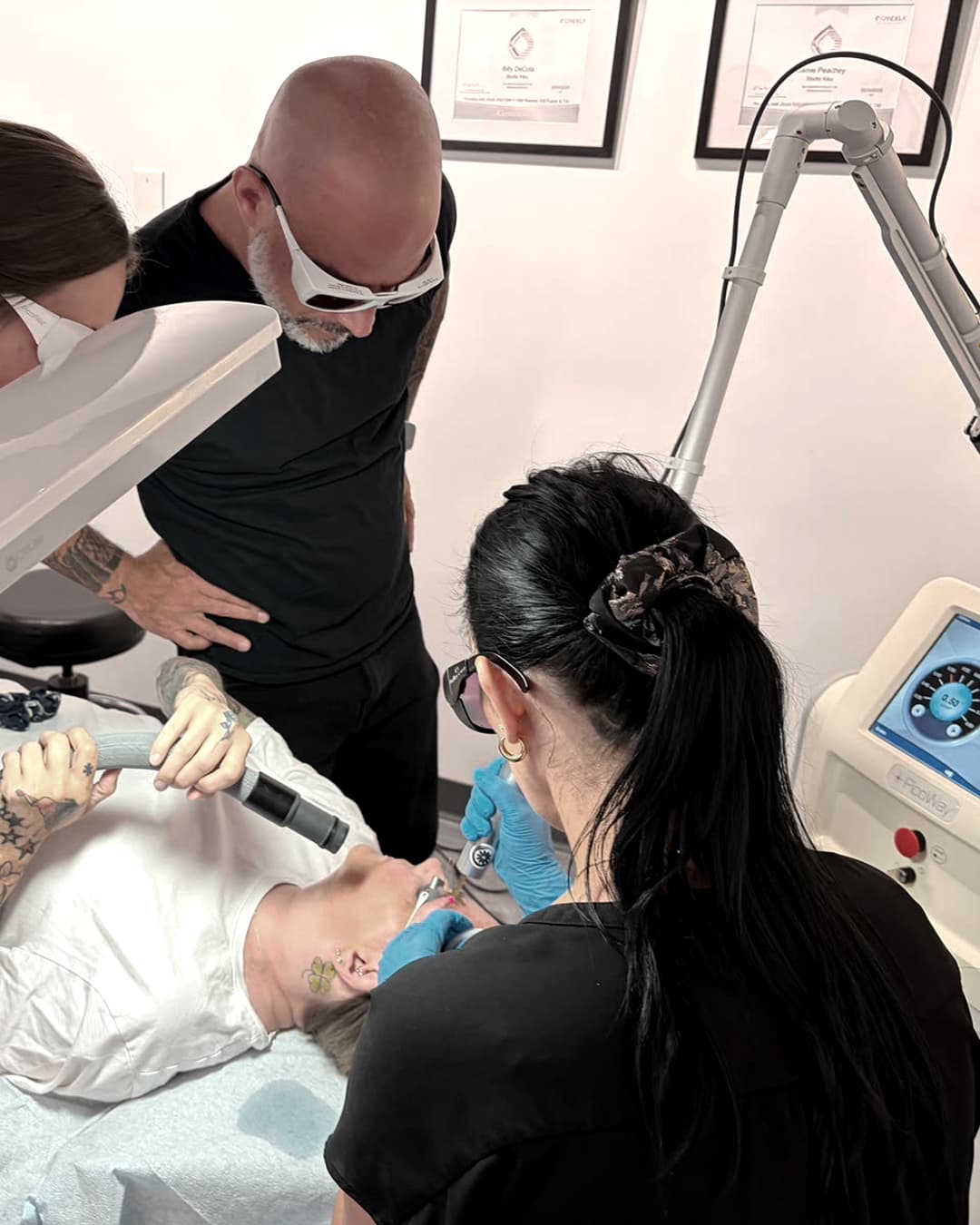
A lot of aesthetics professionals exploring laser tattoo removal have taken an online course. Some have attended a single-day manufacturer event. Very few have spent two full days in an active treatment room working on live models under the guidance of technicians who treat clients every week. That gap is what Studio Kiku's in-person laser tattoo removal certification is built to close.
The course runs over two days at the Vancouver and Langley studios, in small groups, using the PicoWay laser platform by Candela. Every Studio Kiku technician uses the same equipment in daily practice.
What the two-day program covers
The course opens with laser science: how picosecond energy is delivered into the skin, how pigment absorbs that energy and shatters at the particle level, and how the body clears those fragments through the lymphatic system over the weeks that follow. That foundation informs every clinical decision in the treatment room, from reading how the skin is responding to setting accurate expectations during a consultation.
Safety protocol is covered in depth. Laser treatment carries real risks when the equipment is handled without proper training, and students leave with clear procedures for managing the treatment environment, operating the laser confidently, and responding when something unexpected arises.
The hands-on portion covers consultations, treatment protocols, and aftercare across the full case range a working studio sees: body tattoo removal, permanent makeup removal, and SMP removal.
Body tattoo removal and PMU in the same course
Most laser certification programs focus on body tattooing and treat cosmetic pigment as a footnote. Studio Kiku's course gives both equal weight, because they require different clinical approaches.
A body tattoo holds pigment densely and at depth. A cosmetic brow or lip blush typically contains iron oxides or mixed undertones that behave differently under the laser. Oxidation is a real risk during cosmetic pigment removal: a technician trained only on body tattoos is not prepared to advise a client with microbladed brows they want corrected, or to explain what happens when a laser hits pigment containing white.
SMP removal is also included as its own distinct protocol. Students learn how scalp pigment differs from body tattooing, how to assess saturation and depth before a session, and how the approach changes when pigment has migrated or settled unevenly. General laser courses rarely cover this ground.
The instructors are active technicians
Billy DeCola, Ailie Park, and Jamie Peachey teach the course together. All three perform laser treatments at Studio Kiku regularly. What they teach is grounded in the cases they are actively working through.
"There is an art form to removing it just like there is applying it," Billy DeCola said in a recent conversation on The Faded Podcast. "You have to know what settings to use. You have to know the skin, how the skin is going to react, what type of pigment was used."
Billy DeCola has been in the tattoo industry since 2009 and worked on TLC's "NY Ink" and "Miami Ink." Studio Kiku holds Candela Medical Key Opinion Leader status for its clinical work with the PicoWay. Ailie Park and Jamie Peachey co-teach the laser course alongside him; each is an experienced technician working with clients in the studio.
Live models, not practice pads
Supervised treatment on a real person introduces variables that no synthetic material can replicate: variation in skin tone, actual pigment depth, and how the tissue responds in real time. Studio Kiku puts students in the treatment room on day one.
Group sizes are kept small so every student receives direct feedback on their technique, their consultation approach, and their clinical judgement throughout both days. There is no lecture-only segment. Students leave having performed supervised treatments, not having watched them.
Certification is the start, not the finish
Two days of hands-on training builds a solid foundation. It does not produce a finished laser technician, and the course does not present itself that way.
Licensing and scope-of-practice requirements for laser use vary by province. Those requirements are entirely separate from what a Studio Kiku certification covers. Students are responsible for understanding the regulatory environment in their province before offering laser services to clients.
The certificate issued on completion is from Studio Kiku. It confirms that the student completed the course. It is not government authorization to practise. For most students, it is one component of a longer professional development path that includes ongoing mentorship, continued hands-on practice, and staying current with manufacturer training as the technology evolves.
That said, the course is designed to be genuinely useful from day one after completing it. The curriculum reflects the protocols Studio Kiku has refined across thousands of treatments. Students leave with a practical foundation in both the theory and the technique, not just a credential.
For aesthetics professionals considering laser tattoo removal as a new service offering, Studio Kiku welcomes questions in person. Book a free consultation and the team can walk you through what the training covers, what prior experience is helpful, and what the regulatory picture looks like for your practice.
Thanks for reading.