
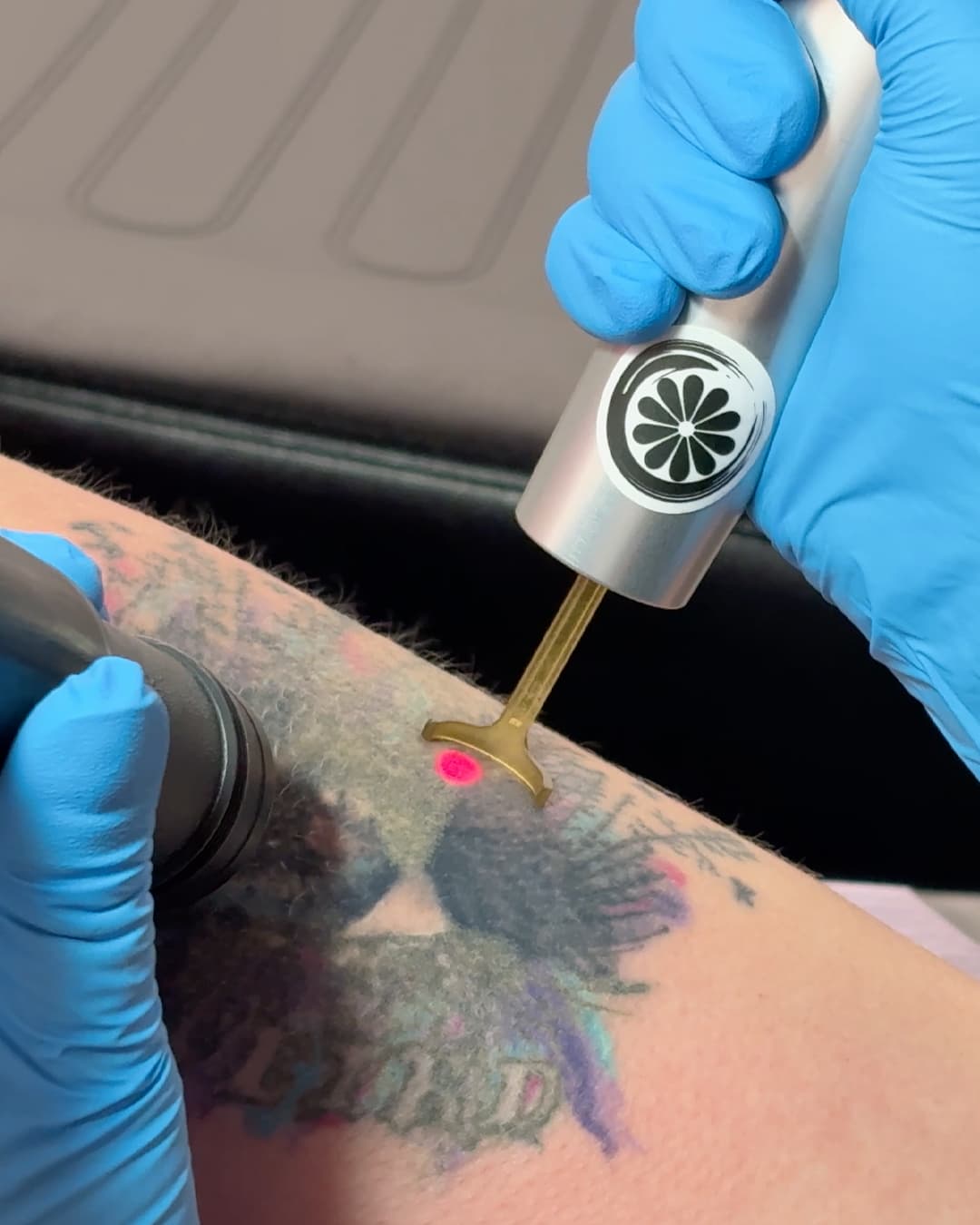
The word "shatter" appears in nearly every description of laser tattoo removal, but it's rarely explained. What does it mean for a laser to shatter pigment under the skin? The answer involves a specific physical process called the photoacoustic effect, and understanding it clarifies something that confuses many people going through treatment: why the skin looks unchanged for weeks after a session, even when everything is working exactly as it should.
Laser tattoo removal is a two-step process. The laser's job is to fragment the pigment into particles small enough for the body to carry away. The body's job is to clear those particles through the lymphatic system, slowly, over weeks and months. Both steps are essential. When either is misunderstood, expectations go sideways.
Sound, not just heat
Older nanosecond lasers work primarily through heat. Laser energy is absorbed by the pigment and converts to thermal energy, which damages and fragments the particles - but that slow heat transfer also stresses the surrounding skin tissue, contributing to blistering risk and a more demanding recovery.
Picosecond laser technology works differently. Because the pulse duration is so short (the Candela PicoWay fires at 300 to 450 picoseconds - trillionths of a second), the energy is delivered faster than heat can meaningfully transfer into the surrounding tissue. Instead of burning, the rapid energy absorption creates an intense photoacoustic effect: a pressure wave that physically fractures the pigment particle from the inside. It's mechanical force rather than thermal damage. The result is more efficient fragmentation with less stress to the surrounding skin.
What happens to the fragments
After fragmentation, the pigment doesn't disappear. It's broken into smaller particles that remain in the dermis until the body's immune response removes them. White blood cells called macrophages engulf the particles and carry them through the lymphatic system, eventually filtering them out through the lymph nodes.
Billy DeCola, Studio Kiku's founder, describes the moment of treatment plainly: "Tattoo removal is a little explosion under your skin, so when that pigment explodes, there is heat involved and the initial ice pack will alleviate that heat."
The particles need to reach a size small enough for macrophages to engulf. Larger fragments stay lodged in the dermis, which is why multiple sessions are required - each one breaks the remaining particles down further until they reach a clearable size. A single session doesn't clear a tattoo; it starts a clearing process that the body then carries forward over the following weeks.
Why the clearing takes longer than the session
The laser session itself is brief. The clearance takes months.
After each session, the body begins carrying fragmented particles away through the lymphatic system. That process is gradual. Most clients see little visible change in the first few weeks after a treatment. The fading that appears at the six-to-eight-week mark often reflects the body finally catching up on fragments produced in the session before.
As Billy explains in a recent episode of The Faded Podcast: "Your lymphatic system takes a long time to get to cleaning those particles up. So what you're gonna be seeing in the first one or two sessions is not much of anything."
This is why sessions at Studio Kiku are spaced a minimum of 8 weeks apart. Coming back sooner doesn't accelerate the clearance - the body is still working through the fragments from last time, and adding more fragmentation before that clearing is underway adds unnecessary skin stress without improving results. Supporting the body between sessions also matters: staying well hydrated, sleeping consistently, and keeping the treated area protected from direct sun all affect how efficiently the lymphatic system clears. The full laser tattoo removal aftercare guide covers this in detail.
What saturation and placement mean for the timeline
Two factors drive how long a full treatment series takes more than any others: how deeply the pigment was placed, and how saturated the tattoo is.
Pigment placed deep in the dermis requires more energy to reach and more fragmentation passes to reduce it to clearable size. Lightly saturated washes - diluted pigment used for soft shading - can fade significantly in one or two sessions. Dark, solid lines placed at full depth take considerably longer. Heavily saturated cover-ups, where multiple layers of pigment sit at varying depths with possible scar tissue underneath, are among the most demanding cases in laser tattoo removal.
Saturation is essentially the quantity of pigment in a given area. More pigment means more particles to fragment, and each session can only accomplish so much fragmentation in a single pass. Results build session by session, and the pace often accelerates in the middle of treatment as the volume of remaining pigment decreases.
When full clearance isn't possible
The photoacoustic effect works well on most pigment types, but not on all of them.
White pigment is the clearest exception. Laser energy can't be absorbed by white pigment, so there's no mechanism to create acoustic waves and no fragmentation occurs. When a laser is applied to white pigment, the result is oxidation - the pigment darkens rather than clearing. Any pigment lightened with white (certain opaque greys, baby blues, and some pinks) carries this risk, and recognising it before treatment starts is part of what makes a consultation valuable.
Yellow is the most resistant of the clearable colours. Even the 532nm wavelength designed specifically for reds, oranges, and yellows can struggle to fully clear yellow pigment. Some yellow undertones left behind in brow pigment after laser removal, for example, won't respond further regardless of additional sessions.
Heavily saturated tattoos with underlying scar tissue present their own set of limits. Complete clearance is achievable for many people and is the goal in a significant share of treatments Studio Kiku carries out. But what's realistic for a specific tattoo depends on the pigment composition, how it was placed, and how a given person's body responds over time. The consultation is where that picture becomes specific rather than general.
A free consultation at Studio Kiku gives you an honest assessment of what the process will involve for your tattoo: how the pigment looks, what a reasonable session range is, and where the limitations are. Book a free consultation at a Studio Kiku studio in Vancouver, Langley, or Vaughan to get started.
Thanks for reading.