
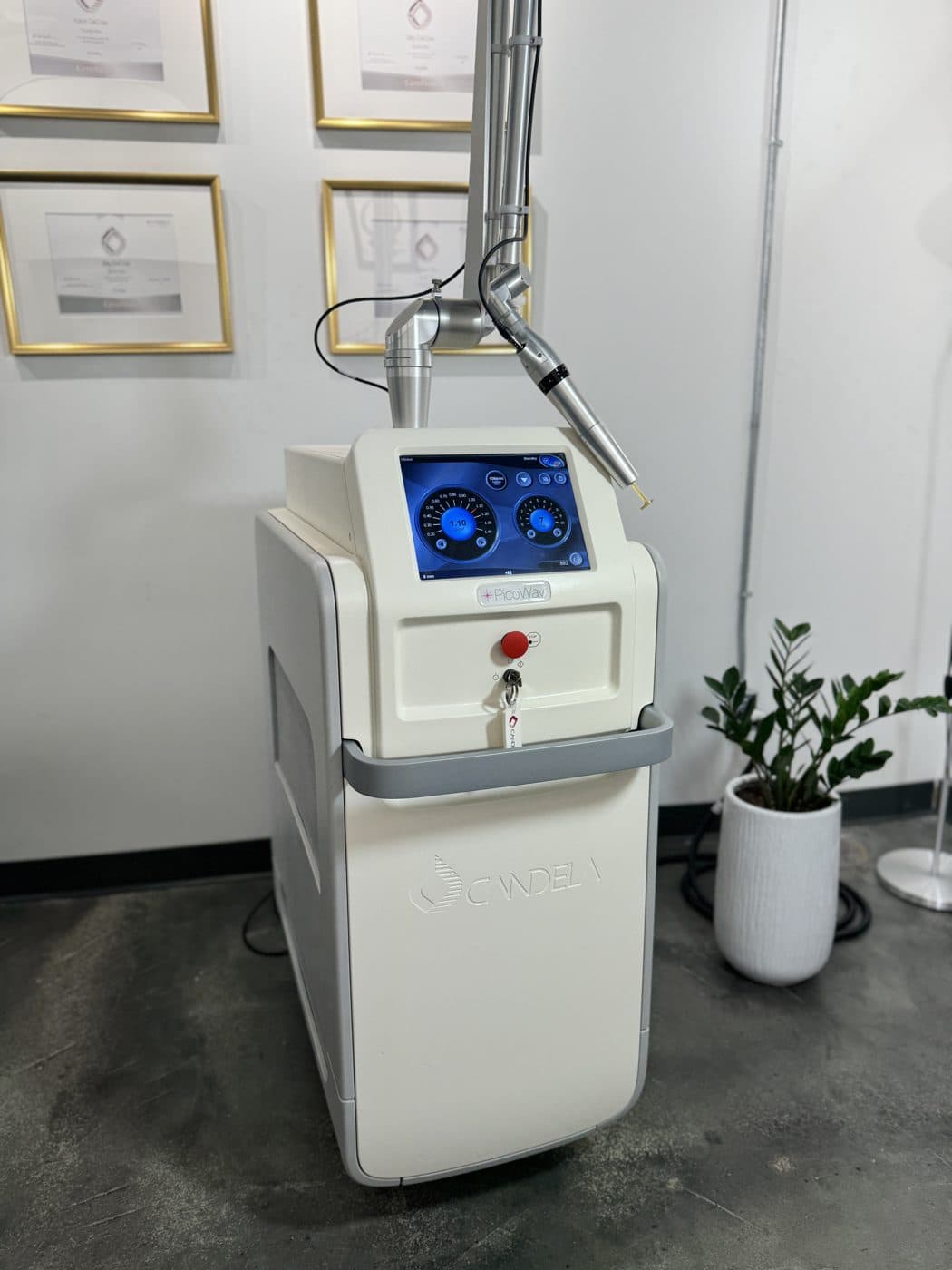
If you have shopped around for tattoo removal, you have almost certainly been told that a studio uses a pico laser. It sounds like a specification. It sounds like something that has been checked. It is worth knowing that the word on its own is neither of those things.
Pico is short for picosecond, which is a unit of time. One picosecond is a trillionth of a second. That is the entire meaning of the word. It describes how briefly a pulse lasts, and it says nothing at all about who built the machine, how much power it delivers, or whether it is any good.
A thousand picoseconds is just a nanosecond wearing a new label
Here is the part that does the most work in this whole conversation. A thousand picoseconds equals one nanosecond. Nanosecond lasers are the older generation of removal technology, the devices that came before picosecond machines existed. Both generations are built on Q-switching, so that term describes the technology they share rather than telling you which one you are standing in front of. Pulse duration is the thing that separates them.
So a device advertising a pulse duration of a thousand picoseconds is not a fast picosecond laser. It is a nanosecond laser, described in smaller units. Nothing about that claim is technically false. The number is real and the unit is real. It just leads a reader somewhere the specification does not go.
This matters because pulse duration is the thing that decides how a laser treats your skin. A shorter pulse delivers its energy faster than the surrounding tissue can conduct heat away, so it shatters pigment mechanically. A longer pulse leaves more of that energy behind as heat, and heat is what drives most of the risk in laser work: blistering, pigment change, and scarring.
The machines sold on Amazon and Alibaba
Search either marketplace and you will find handheld laser pens and full trolley units, many of them labelled pico, at prices that would not cover a single service call on a professional device. Some are sold to studios. Some are sold directly to people intending to treat themselves at home.
"Just because the device says Pico on it, that does not mean that it's safe. It does not mean that it's effective, and it definitely doesn't mean that it won't damage your skin," says Billy DeCola, Studio Kiku founder.
He puts the bottom tier of the market plainly on the podcast: the unknown lasers, the ones you find on Amazon, Alibaba, or from your cousin at a garage sale. They frequently say pico on the housing and sit north of a thousand picoseconds.
The risk is not hypothetical. The UK's product safety regulator has published a formal safety report on a laser pen sold through Amazon, finding a serious risk of burns and eye damage. A device powerful enough to affect pigment under your skin is powerful enough to injure you, and that is true whether it arrived in a shipping crate or a padded envelope.
Quality in this category is brand-specific
Because the word is not a standard, the only thing that actually distinguishes one pico laser from another is the manufacturer and the specification sheet behind it. Among the professionally built platforms, published pulse durations span a genuinely wide band, from roughly 750 picoseconds at the slower end down to around 300 at the fastest. Every one of those is sold as a pico laser. They are not doing the same thing to your skin.
Studio Kiku treats on the PicoWay by Candela, which runs 300 to 450 picoseconds and carries the 1064, 730 and 532 nanometre wavelengths. Billy walks through the whole field, naming each brand and its pulse duration, in Not all picosecond lasers are created equal on the Faded Podcast. It is the most direct answer we have published to the question of which machine is which.
If you take one practical thing from this, make it the question you ask. Not "do you use a pico laser", which almost everyone can answer yes to. Ask which manufacturer built it, which model it is, and what its pulse duration is. A studio that knows its equipment will answer all three without hesitating.
The machine is only half of what you are paying for
An honest version of this argument has to include its own limit. A fast laser in careless hands is worse than a slower laser in careful ones. Wavelength selection, conservative settings, honest spacing between sessions, and knowing when to stop are judgment calls made by a technician, and no specification sheet makes them for you.
Equipment is also not a promise of a particular outcome. Some pigments resist every wavelength. Some tattoos carry scar tissue from the original work that will still be there when the pigment is gone. Sessions are spaced a minimum of eight weeks apart because the clearing is done by your body between appointments, not by the laser during them, and no machine shortens that. Anyone telling you otherwise is selling you the word, not the result.
What the right machine does is raise the ceiling on what good technique can achieve, and lower the risk while getting there. That is worth a great deal. It is just not the whole job.
If you are weighing where to go for laser tattoo removal, the team is happy to talk through your pigment, your skin, and what is realistic before you commit to anything. Consultations are free, and you are welcome to bring your equipment questions with you. You can book one online.
Thanks for reading.