
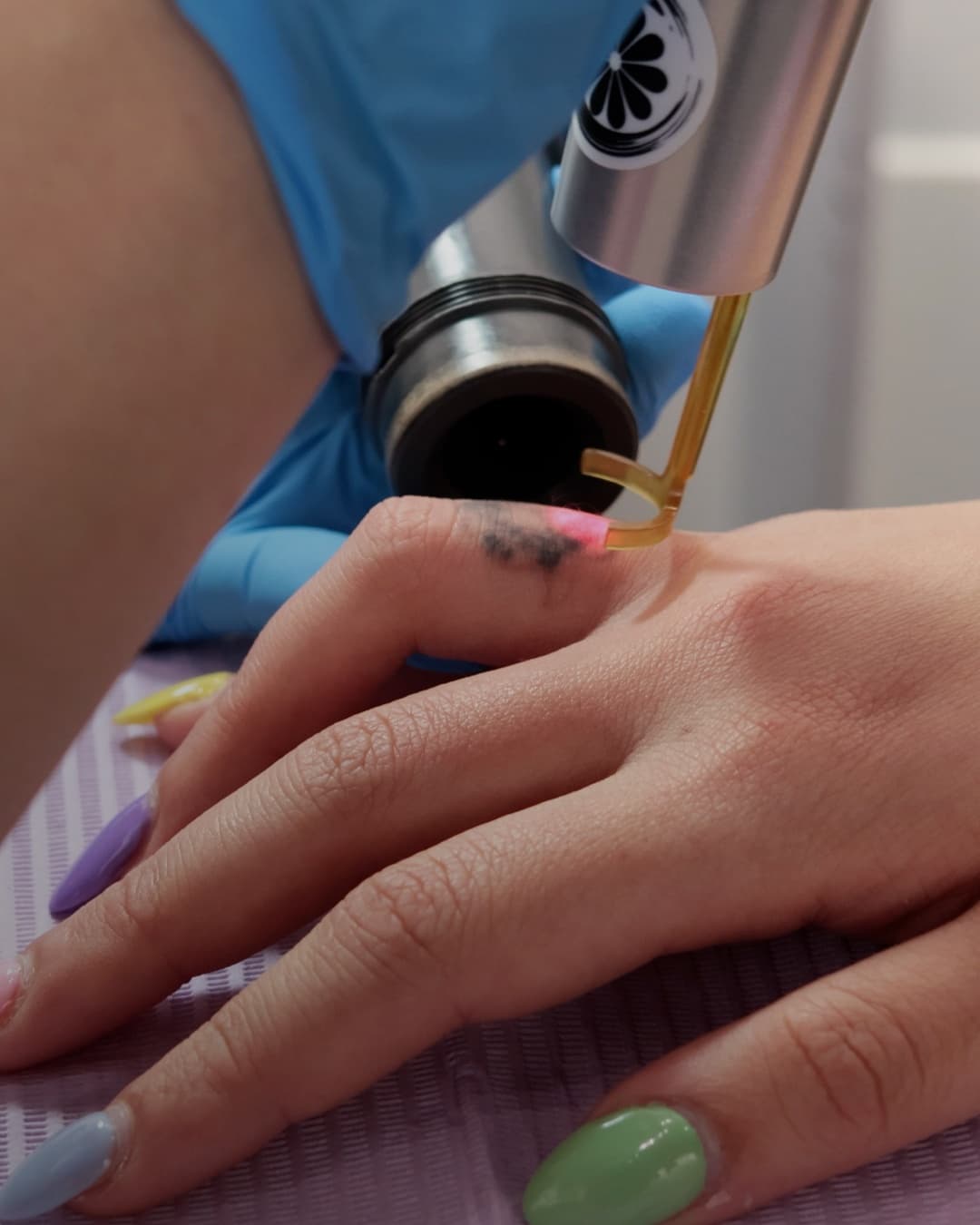
Laser removal works on finger tattoos. The process just requires more patience than most people expect, and a technique that protects the skin throughout.
Fingers are one of the most common treatment areas at Studio Kiku, and also one of the areas where clients arrive with the biggest gap between what they've been told elsewhere and what's actually realistic. Understanding why fingers behave differently from the rest of the body makes a real difference in how clients approach the process.
Why fingers take longer
The skin on fingers is thin and sits directly over bone, with minimal soft tissue beneath it. Fingers also move constantly: they bend, grip, and flex throughout the day, which means the treated area is under repeated mechanical stress in the weeks between sessions.
The bigger factor is circulation. The body clears fragmented pigment through the lymphatic system, and lymphatic flow is strongest close to the core. The further from the torso, the slower that clearance becomes.
Billy DeCola, Studio Kiku founder, explains it plainly: "Depending on the location on your body, wherever there's more flow going on, you're going to have better results. Anything on your torso or upper body, you're going to have better results than you will on any of your fingers, toes, feet, that type of thing. The farther away on your appendages, the slower the removal process is going to be. That's just a fact."
What the treatment looks like
Studio Kiku uses the PicoWay laser by Candela Medical for finger tattoo removal. The PicoWay delivers extremely short pulses of energy in the picosecond range, fragmenting pigment efficiently while minimising impact to the surrounding tissue. A Zimmer cooling device runs alongside the laser throughout the session to keep the area comfortable.
Technique matters as much as equipment on fingers. Because the skin is thin, the team starts at conservative settings in early sessions and adjusts gradually as fading progresses. Working too aggressively early on risks scar tissue or permanent pigment changes in the skin, which is why the approach here is measured rather than fast.
Sessions are spaced at least 8 weeks apart to give the body adequate time to clear the shattered pigment before the next treatment.
How many sessions to expect
More than you would need for a tattoo elsewhere on the body. A standard laser tattoo removal on the torso or upper arm typically takes 9 to 12 sessions for complete removal. Fingers fall into a similar or longer range, and fading tends to progress more slowly between sessions compared with areas closer to the core.
For clients who want the tattoo fully gone, the Complete Removal Package is a flat-rate option that covers as many sessions as it takes. When the session count is harder to predict, as it often is with fingers, a fixed rate simplifies the commitment.
Why some finger tattoos never fully clear
Not every finger tattoo will clear completely, even with the right laser and proper technique. A few factors can limit results:
- Heavy pigment saturation close to the bone is harder to treat at settings that keep the skin safe.
- Light-coloured pigment, including white, light blue, and pink, may not fully clear regardless of location.
- Scar tissue from the original tattooing can restrict how well the pigment responds to the laser.
- Blowout or blurring in the original tattoo may soften but not fully resolve.
Every one of these factors gets reviewed at the consultation before any treatment begins. If what a client hopes for doesn't match what is realistically achievable, that conversation happens upfront.
Before your first session
A few things to take care of in the lead-up to treatment:
- Avoid sun and self-tanners on your hands for two weeks before the session.
- Stop retinol, vitamin C, and exfoliants ten days before treatment.
- Wait at least 12 weeks after the tattoo was applied before starting removal.
- Remove any jewellery near the treatment area before your appointment.
If the goal is to fade the tattoo for a cover-up rather than remove it entirely, let the team know at the consultation. The process is the same, but the session target is different and shapes the plan from the start.
If a finger tattoo has run its course, book a free consultation in Vancouver, Langley, or Vaughan. The technician will examine the pigment and the skin over each knuckle, and set expectations that match how fingers actually clear.
Thanks for reading.