
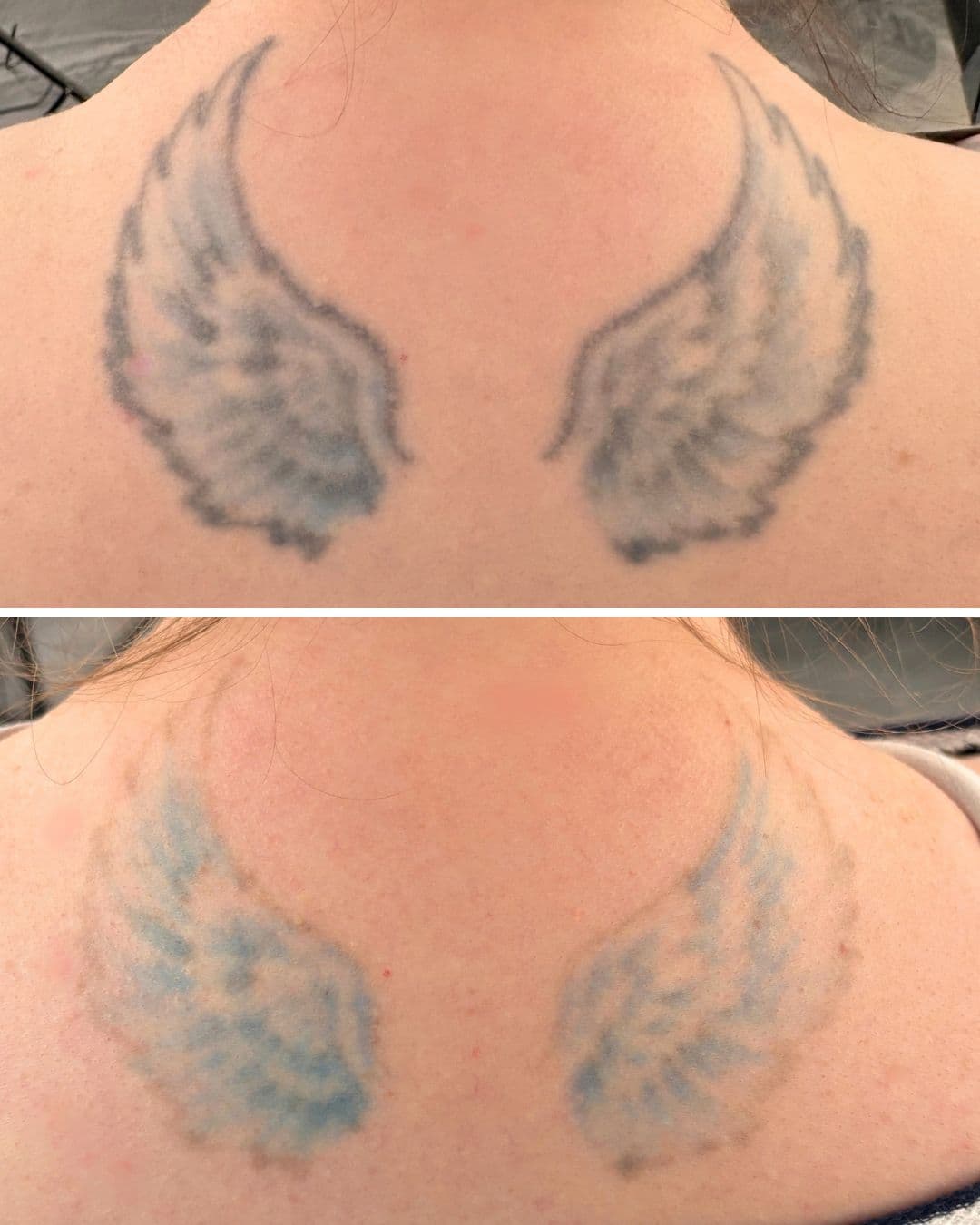
These angel wings read as black and grey the day they were photographed for the first time. Three sessions of laser later, most of the black is gone and what is sitting in the feathers instead is blue. Clients who see this on their own skin almost always reach the same conclusion first, which is that the laser did something to the tattoo.
It didn't. A tattoo that looks bluer partway through removal is one of the more predictable things in the whole process, and it says more about how the tattoo was built than about how it's being treated.
Black clears first, and it clears loudest
Black is the easiest pigment to shift, because it doesn't reflect laser energy back out of the skin. It absorbs it. That's why in a piece with heavy black shading and some colour underneath, the dark elements drop away earliest and most dramatically, while everything else holds its ground.
The result is a tattoo that looks lopsided in the middle of laser tattoo removal. The parts that responded fastest are the parts you noticed most, so their absence is obvious. The parts that haven't responded yet are suddenly the loudest thing left on the skin.
The blue didn't appear, it was uncovered
Whatever blue is in a tattoo, whether the artist laid it in as its own colour or worked it into the shading, it was there from day one. Heavy black sitting over top of it, around it, and mixed through it is what kept it from reading as blue. Remove enough of that black and the blue has nothing left to hide behind.
PMU removal does the same thing on a smaller scale. Brow pigment almost always has a warm undertone mixed into it, the dark layer lifts first, and clients come back after a session or two asking why their brows went orange. Same mechanism, different colour. Nothing was added. Something was taken away.
Blue sits under a different wavelength
Pigment colours don't all respond to the same light. The PicoWay carries several wavelengths precisely for this reason: dark pigment is treated at 1064 nm, and greens and blues are targeted at 730 nm. On these wings, the next session or two will run the 730 at the blue that the earlier sessions exposed.
That's also why a studio's equipment list is worth asking about before a colour piece is started. A device with one wavelength can take the black out of a tattoo and then stall completely on what's underneath.
There's a limit to that logic, and Billy DeCola, Studio Kiku's founder, states it plainly: "And no matter what the manufacturer of a laser says, there is not a wavelength for every single colour out there." More wavelengths widen what's treatable. They don't make every pigment treatable.
When a blue has white mixed into it
Here's the part that decides how far a blue actually goes. A true blue has a wavelength matched to it and generally responds. A pale or powdery blue is usually a blue that was lightened with white pigment, and white behaves badly under a laser.
As Billy puts it: "Any colours that are mixed with white, like baby blue, pink, lavender, even light yellow, any peach, any of those colours, they're very difficult, if not impossible to remove with the laser. Why? Because they contain white. White has a tendency of oxidizing, and it does not come out."
Oxidizing means the pigment darkens rather than lifting, and once it has darkened, more sessions don't reverse it. Light blues, pinks and certain opaque greys all carry that risk, which is why a technician looks hard at a pale area before treating it and will sometimes recommend a test spot or recommend leaving it alone entirely. Complete clearance is never promised on any tattoo, and a piece with light, white-lightened colour in it is the most common reason a removal stops short of bare skin.
What the next sessions are actually aiming at
Once the blue is being targeted directly, the pace doesn't change. Sessions stay a minimum of 8 weeks apart, because the laser only fragments the pigment and your body does the clearing in the weeks that follow. Pushing the settings or shortening the gap to chase the blue faster is how skin gets damaged.
Billy is blunt about what the real target is: "The goal is not speed, it is keeping the skin intact when the tattoo is gone." On these wings, that means no hypopigmentation, no hyperpigmentation, and no scar in the shape of a feather once the pigment has cleared. He walks through more of these mid-process photos in Laser tattoo removal before and after: real results on the Faded Podcast.
Before you call the blue a problem
If a tattoo of yours has gone bluer, greener or warmer since removal started, that's worth looking at in person rather than worrying about from a photo on your phone. Consultations at Studio Kiku are free, and a technician can tell you what colour is actually left, whether it has a wavelength matched to it, and how far the piece is likely to go. Book a free consultation at whichever studio is closest to you in Vancouver, Langley or Vaughan.
Thanks for reading.