
Fine line tattoos are designed to sit light on the skin. The style uses a single needle or a tight grouping, soft stippled shading, and a lot of bare skin showing through the design. That same restraint is why fine line work behaves differently under a laser than a heavy traditional piece does.
Laser removal responds to how much pigment is sitting in the skin, not to how large or how detailed the design happens to be. A delicate forearm piece can hold a small fraction of the pigment that a solid black band of the same size holds, and that difference starts showing up early.
What saturation means for a delicate piece
Saturation is the amount of pigment packed into a given area of skin. Fine line work is usually built from thin outlines and stippled or whipped shading, which means the artist placed far less pigment per square centimetre than a filled traditional tattoo requires. The laser still has to fragment every particle it finds, but there is less of it to break apart, and your lymphatic system has less to carry away between visits.
"You can look at a very soft black and gray tattoo that doesn't have much saturation, it's just some very light shading. That's going to come right out," says Billy DeCola, Studio Kiku founder.
Depth matters alongside density. Fine line and outline-style work is often placed more shallowly than heavy traditional fill, and shallower pigment is easier for the body to reach once it has been fragmented.
What one session can look like
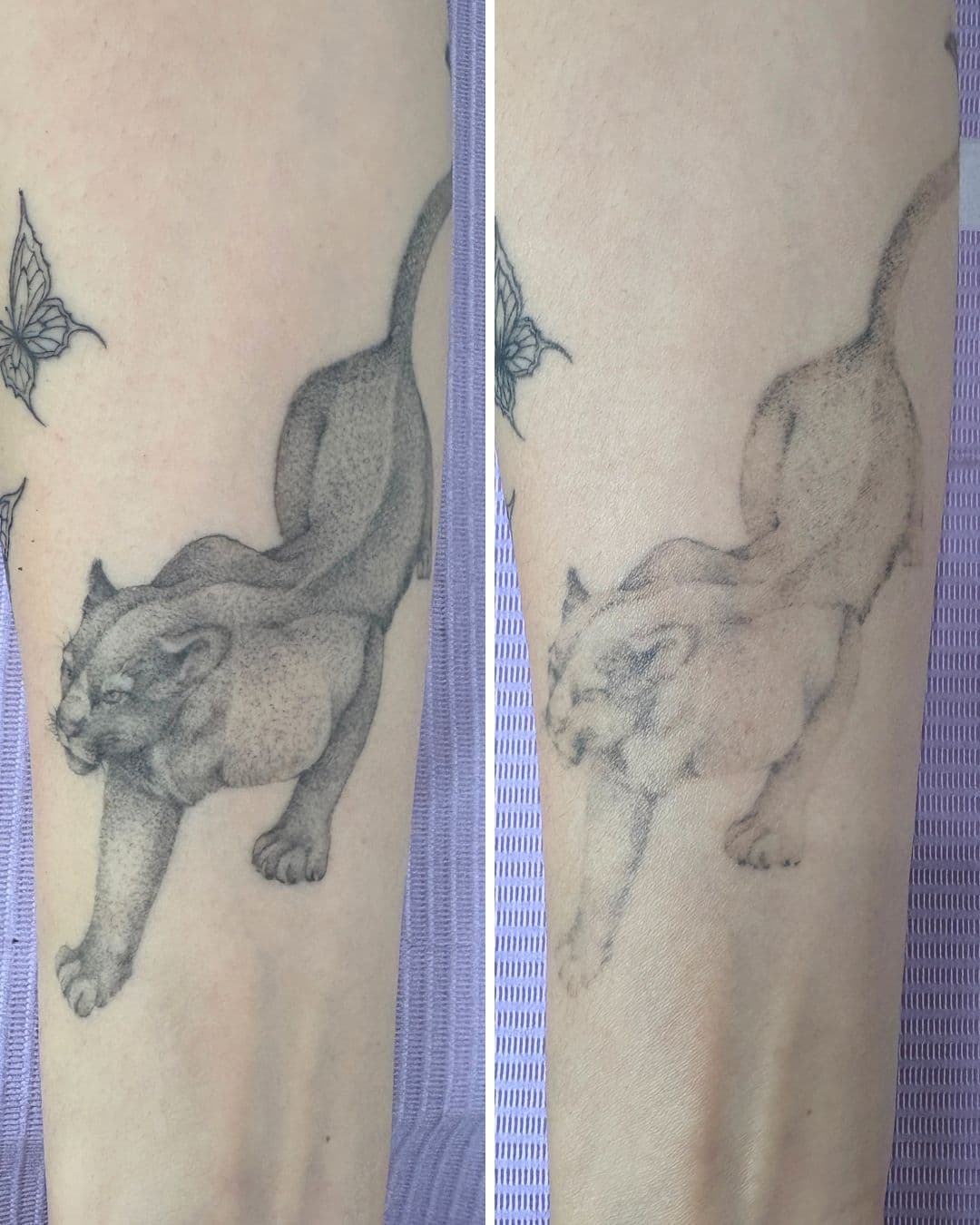
The photograph above is a single laser tattoo removal session on a stippled black and grey piece. Most of the soft shading inside the body of the design has dropped back toward the skin tone, while the darker outline is still clearly readable. That split between shading and line is the usual pattern, because the two parts of the design were never carrying the same pigment load.
"If you had some very light shading or some very shallow scratchy work, then you will see that part of the tattoo fade," Billy DeCola explains.
What matters is that this is not the normal arc for a dark, saturated tattoo. Laser removal takes time, and it can take two or three sessions on dense work before the change is noticeable at all. Fine line pieces are the category most likely to look different early, and even then the light areas move first while the outline takes its own series of sessions.
The laser itself is part of why the shading lifts cleanly rather than cooking the surrounding skin. The PicoWay fires in the picosecond range, one trillionth of a second per pulse, which fragments pigment largely through photoacoustic pressure rather than sustained heat.
Session count on lighter work
Studio Kiku quotes 3 to 6 sessions for fading and 9 to 12 for complete removal of a dark, saturated tattoo. Those ranges describe dense work. Lightly saturated designs generally need fewer than a packed piece of the same size, though nobody can name the exact number from a photo. Saturation, how deep the pigment was placed, the type of pigment used and any scar tissue left by the original tattooing all shape the count.
Sessions are spaced a minimum of 8 weeks apart whatever the style. The clearing happens between appointments rather than during them, so the calendar is set by your body, not by how quickly you want the piece gone. Laser tattoo removal starts at $100 per session, and the Complete Removal Package is one flat rate covering as many sessions as the tattoo takes, which suits people who would rather know the total up front than count visits.
When the grey is not just diluted black
Black and grey tattoos get their grey two different ways, and the two behave nothing alike under a laser. One is a wash, which is black pigment diluted down with water. A wash is the kind of soft shading that tends to clear readily. The other is an opaque grey, made by mixing black with white rather than thinning it, and white is the problem. White pigment does not clear with laser, and treating it can cause it to oxidize and turn darker instead of lighter.
From the outside, a delicate grey wash and an opaque grey can look similar. That is why Studio Kiku assesses the piece before any treatment and will say plainly when a design is a poor candidate, rather than starting a series that cannot finish. White and light pigments, including pale blues and pinks, may not fully clear even in an otherwise straightforward piece.
Complete clearance is never promised on any tattoo. Significant fading is achievable in most cases, and fine line work is among the more cooperative material the studio sees.
Bringing a fine line piece in
Consultations at Studio Kiku are free, and a delicate piece is worth looking at closely before anything is booked, since the greys and the depth are what decide the plan. Book a free consultation in Vancouver, Langley or Vaughan and you will leave knowing what the design is made of and roughly what the series ahead of you looks like.
Thanks for reading.