
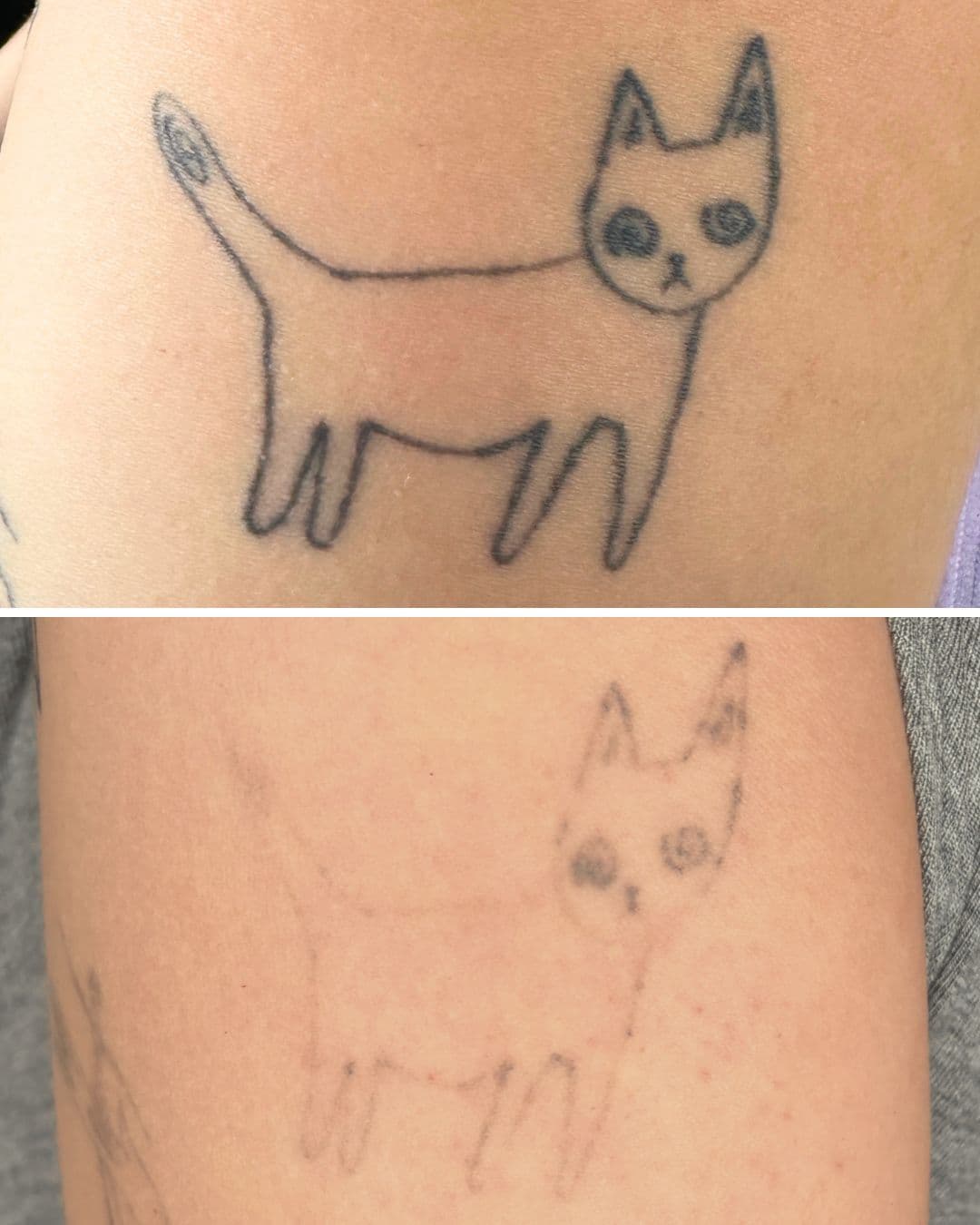
The cat outline in this photo was nearly gone after 3 sessions. That's not a record, and it's not a mystery - it's a predictable outcome for a tattoo with these specific characteristics. Understanding why helps set realistic expectations before you start removal, regardless of what you're working with.
Laser tattoo removal works the same way on every client: the laser shatters the pigment into particles small enough for the body's lymphatic system to clear over the following weeks. The laser itself is fast. What varies is the starting point - how much pigment is there, what colour it is, and how deeply it sits in the skin.
What makes this tattoo a fast mover
The cat drawing in the before photo has three characteristics that favour quick clearance.
First, it's an outline-only design. There's no solid fill, no shading, no layered passes of pigment. The total volume of pigment the body needs to clear is small compared with a traditionally filled or heavily saturated tattoo. Less pigment to start means fewer sessions for the body to do its clearing work.
Second, the pigment is almost entirely black. Black absorbs laser energy across multiple wavelengths, which makes it one of the most responsive colours to picosecond laser treatment. The PicoWay breaks black pigment efficiently, and the body recognises and clears the shattered particles readily.
Third, the tattoo sits in an area with good circulation - the upper arm - which supports the immune system's ability to carry away broken pigment between sessions. Placement on areas with slower circulation, such as the ankles or the sides of the fingers, tends to mean slower progress even when everything else is equal.
None of these factors were chosen strategically. They're just what this particular tattoo happened to be. But they combine into an ideal scenario for fast clearance.
How saturation shapes session count
A heavily saturated tattoo - solid black fill, thick outlines, multiple passes of dense pigment - holds far more pigment per square centimetre than a simple line drawing. Each laser session does the same amount of work. A more saturated tattoo needs more sessions simply because there's more total pigment for the body to process.
Studio Kiku estimates 3 to 6 sessions for significant fading on lightly saturated work, and 9 to 12 sessions for complete removal of a dense, saturated piece. Those aren't opposite ends of a spectrum with a single cause - they reflect the cumulative effect of density, colour, depth, and placement all varying together.
"The laser breaks down the pigment," says Billy DeCola, Studio Kiku founder. "But your immune system is what actually clears it." That clearing takes weeks after each session, and the more pigment there is to clear, the more sessions the body needs to make meaningful visible progress.
Why colour matters beyond just black
Black clears fastest because it absorbs laser energy well at the wavelengths available on the PicoWay. Darker colours in general - deep navy, dark green, dark red - respond better than lighter or brighter pigments.
Bright yellows, light greens, and pastels are the most resistant. They absorb less of the laser's energy, which means each session has less effect and more sessions may be needed to achieve the same degree of fade. Some lighter pigments don't fully clear regardless of session count - a reality the Studio Kiku team addresses directly at the consultation before any treatment begins.
Pigment colour is the main reason a multicolour tattoo with bright elements will typically take longer than an all-black piece of similar size and saturation.
When nearly gone isn't quite there yet
Three sessions and nearly gone is genuinely good progress, but "nearly gone" still leaves room for a faint remaining trace. In the after photo, the outline of the cat is substantially cleared - but look closely and the lightest remnants are still visible.
For most clients, that final trace is either tolerable or addressable in one more session. For clients planning to cover the area with a new tattoo, that level of clearance is usually more than enough - a faint ghost disappears under fresh pigment without any issue.
For complete clearance to bare skin, it's worth knowing that even the fastest-responding tattoos may require patience with those last stubborn particles. The body keeps clearing shattered pigment for weeks after each session, which is why spacing sessions a minimum of 8 weeks apart - and often longer later in the process - gives the best final result.
The Complete Removal Package covers as many sessions as the removal takes at one flat rate. For a light, quickly-fading tattoo, it may not be necessary. For anyone who wants certainty regardless of the session count, it removes the uncertainty of paying session by session and wondering when the end arrives.
If you'd like a direct read on what your tattoo's specific characteristics mean for the likely session count, book a free consultation at Studio Kiku in Vancouver, Langley, or Vaughan. The team assesses saturation, colour, placement, and depth in person, and gives you a realistic estimate before any treatment begins.
Thanks for reading.