
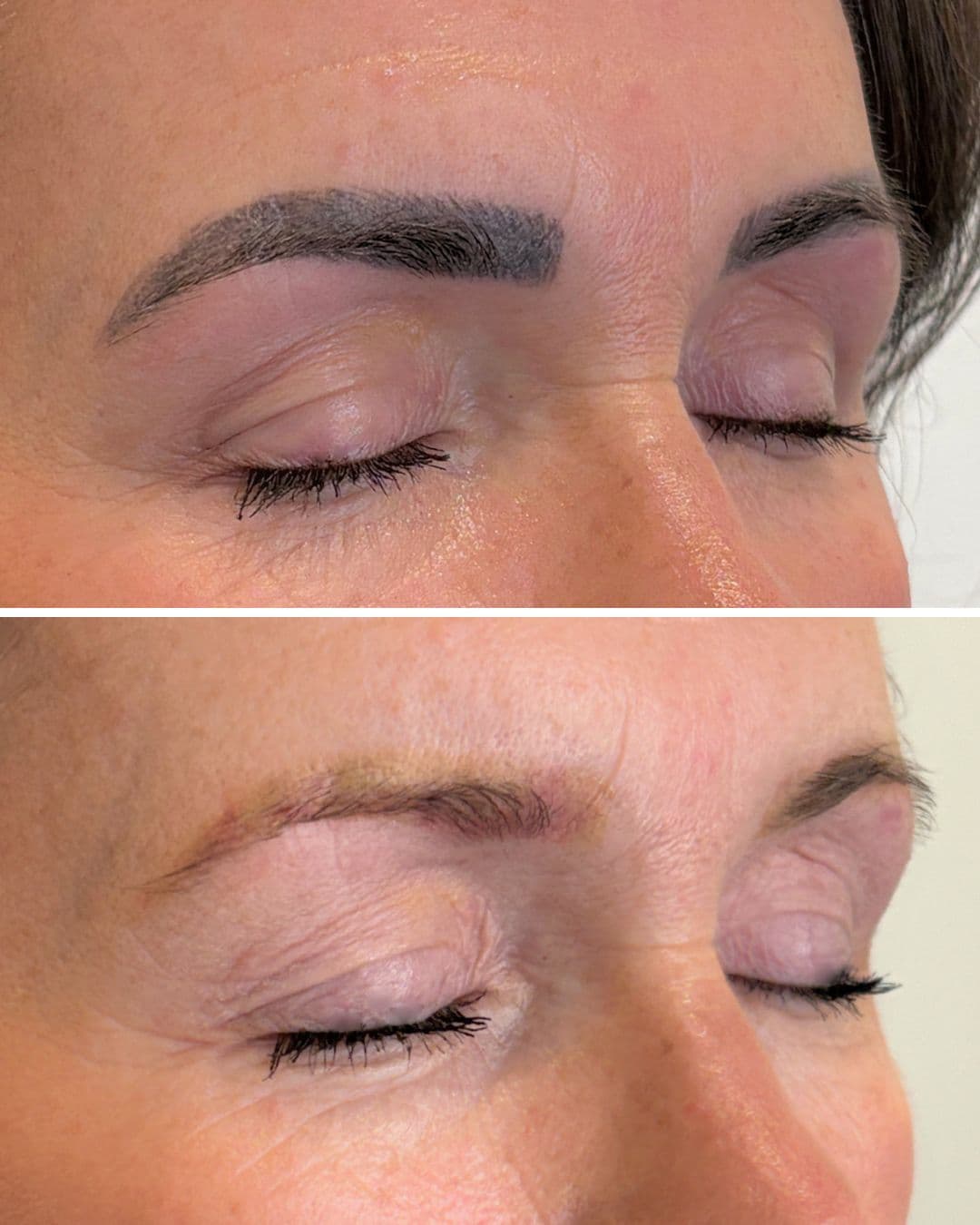
There's a moment in PMU brow removal that catches a lot of people off guard. The dark pigment lifts. The brows look significantly lighter. Then, a couple of weeks later, a warm yellow undertone appears from underneath - and it's not moving. That yellow wasn't new. It was always there, underneath the dark layer, and the laser has done exactly what it was supposed to do: clear the dark pigment and reveal what it was hiding.
Understanding why yellow appears - and why it behaves so differently from the darker pigment above it - is the key to knowing what to expect from the sessions ahead.
Why dark brow pigment lifts first
PMU brow pigments are typically layered. An artist applies a base colour for structure, then adds mixed tones to arrive at the right shade for healed brows. The result is a brow that reads dark brown or nearly black on the surface but contains undertones - often red, orange, or yellow - blended beneath.
The PicoWay laser targets what it can see. The 1064 nanometre wavelength, the primary wavelength used in the first sessions, is optimised for dark pigment. It shatters that dark pigment into fragments small enough for the body to carry away through the lymphatic system over the following weeks.
Once the dark layer is cleared, the undertones below it become the new surface. That's not a treatment failure. It's the treatment working in sequence - the only order the pigment can come out.
What the 532 wavelength does - and where it stops
When red or orange undertones appear after the dark pigment has lifted, the team switches wavelengths. The 532 nanometre wavelength targets warmer colours, and red responds well to it. Often a single additional session clears visible red tones, and the brows look much closer to bare skin.
Then the skin settles. The post-treatment redness fades. And the yellow that was hidden underneath the inflammation becomes visible.
Yellow is classified as a "sunset colour" - meaning it should, in theory, respond to the 532 wavelength. In practice, most yellow PMU pigments resist it.
"Most yellows are resistant to the laser," says Billy DeCola, Studio Kiku founder. "In many cases it's impossible to remove."
The reason comes down to how yellow pigment absorbs laser energy. Even when the wavelength is appropriate, yellow does not always convert that energy into the photomechanical shattering that clears dark and red pigment efficiently. The laser passes through it, or the energy is absorbed in a way that doesn't break the particles down.
The risk of pushing too hard
The instinct when yellow doesn't respond is to treat it more aggressively. More energy, more passes. That instinct leads to a worse outcome.
When yellow pigment absorbs laser energy without shattering, it oxidizes. Oxidized yellow turns dark. A stubborn, faded undertone that was at least manageable becomes a darker, more saturated version of the problem - and now the brows look worse than before the last session.
This is why Studio Kiku approaches yellow carefully. The team uses gentler parameters and monitors the response over multiple sessions, spaced at least eight weeks apart to give the skin time to recover and the body time to clear whatever fragments do loosen. The goal is to protect the skin while looking for a slow, gradual fade - not to chase a result that aggressive treatment can make permanent.
When the laser has reached its limit on yellow
If yellow pigment hasn't shifted after several sessions at appropriate intervals, additional laser sessions are unlikely to change that. The laser has reached what it can do.
At that point, a few options exist. Some clients choose to live with the remaining yellow and cover it with brow makeup daily. Others return to a PMU artist to re-tattoo over the brows in the original shape - which conceals the yellow under a fresh pigment layer, though it does mean committing to the same brow shape and an ongoing relationship with permanent makeup.
The third option is saline removal, which works at the pigment layer without laser energy. A sterile saline solution is introduced into the skin through micro-channels, drawing pigment up as the skin heals. Saline removal has lifted stubborn yellow in some cases. It hasn't in others. It also carries its own risks if performed without experience - including scar tissue and pigment that still doesn't move.
Billy DeCola covers this situation in depth in the podcast episode Yellow Brows After Laser Removal, including why yellow is so unpredictable and what he tells clients who are dealing with it.
Whether any of these options fits a particular case is a conversation that only makes sense with the brows in front of a technician. The colour, saturation, depth, and how much has already cleared all shape what's realistic from here.
If you're working through PMU brow removal and yellow undertones have become the sticking point, a free consultation is the right next step. The team at Studio Kiku can assess what's left in the skin, what's moved and what hasn't, and what options are genuinely worth considering. Book a free consultation in Vancouver, Langley, or Vaughan.
Thanks for reading.