
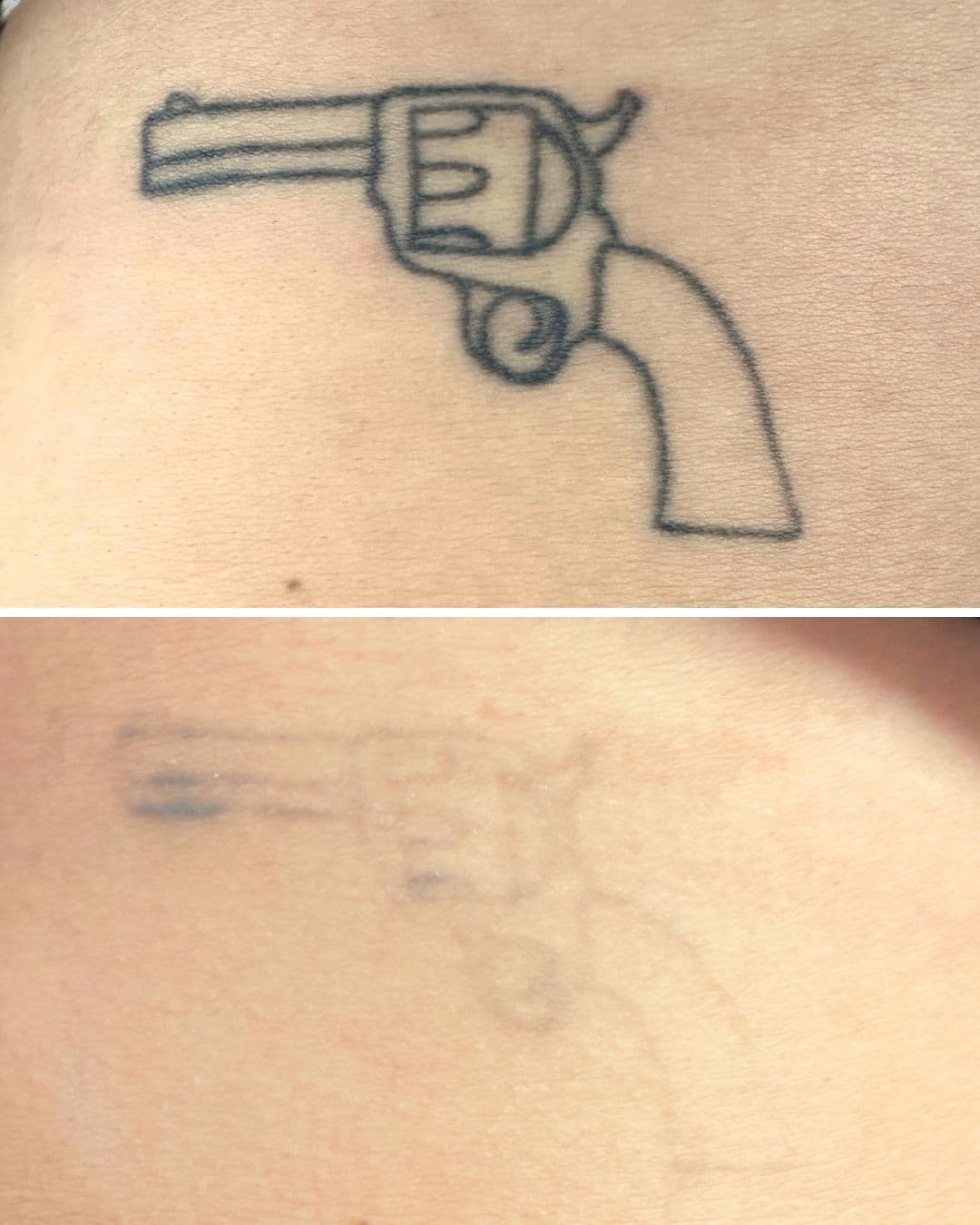
A heavily saturated tattoo filled with dense, layered black pigment does not respond to laser the same way a simple outline piece does. After the first session, it may look almost unchanged. After the second, the progress can be hard to see. If you are several sessions into removing a piece like that and the end still feels far away, the trajectory might be exactly right - even when it does not feel like it.
The photo above shows a revolver tattoo before and after 6 sessions at Studio Kiku. Before: bold black outlines, solid fill, dense pigment throughout. After: that same tattoo reduced to a faint ghost, most of the pigment cleared. That is what six sessions achieves on a deeply saturated piece - not total clearance yet, but a transformation worth seeing.
What "deeply saturated" actually means for removal
Saturation is pigment density. A tattoo built from multiple passes of pigment, with solid fill and thick outlines, holds far more pigment per square centimetre than a fine-line design of the same size. That pigment sits in layers, and those layers have to be addressed one session at a time.
Each session, the laser shatters a portion of the pigment into particles small enough for the body's lymphatic system to carry away. A lightly saturated tattoo might show meaningful visible fading after just two sessions. A dense, saturated piece gives up progress more gradually because there is so much more total pigment for the body to process. The laser does the same amount of work per session - the scale of the task is just larger.
Why early sessions can feel underwhelming
The first session on a heavily saturated tattoo does real work. The frustration is one of perception: clearing a significant portion of a very large total volume of pigment may not look dramatic from the outside, even though the laser and your body are both doing exactly what they should.
This is where patience separates clients who see a removal through from clients who stop too soon. The progress is real and cumulative. By session three or four it becomes impossible to ignore. By session six on a piece like the revolver shown here, the transformation is undeniable.
What your body is doing between sessions
The laser session itself is fast. The actual removal happens in the weeks that follow, as the body clears shattered pigment particles through the lymphatic system. Sessions for heavily saturated work should be spaced a minimum of 8 weeks apart, and waiting longer - closer to 12 to 16 weeks - often produces a noticeably cleaner result by the time the next session starts.
Billy DeCola, Studio Kiku's founder, is direct about this: "Waiting longer is going to allow your body more time to break down the broken pigment particles. You're going to spend less money, you're going to go through less pain and you're going to see just as good of results as you would if you kept coming in every six to eight weeks and hammering away on that tattoo."
For densely packed tattoos especially, that extra time between sessions translates to real visible difference at the start of the next one.
How session count scales with density
Studio Kiku quotes a typical range of 9 to 12 sessions for complete removal of dark, saturated work. That is not a worst case - it is a realistic expectation for heavily packed tattoos. The revolver above at 6 sessions is well along that arc: the bulk of the pigment is gone, but the full removal is not yet finished. That is exactly where a densely pigmented tattoo should be at the midpoint of a complete removal.
Lightly saturated pieces - outlines, fine-line designs, minimal shading - often resolve in 3 to 6 sessions. The density of what you are starting with determines which range applies. A consultation at Studio Kiku includes an in-person assessment of saturation and depth so you go in with a realistic session estimate before the first treatment, not after several.
When a flat rate makes sense
For a heavily saturated tattoo, not knowing the final session count can feel financially uncertain. The Complete Removal Package addresses this by covering as many sessions as the removal takes at one flat rate. For dense work that might need 10 or 12 sessions, locking in the cost up front removes the uncertainty that builds session by session.
The package is not available for all tattoos. Cover-ups, tattoos with scar tissue from prior work, or tattoos that have had prior laser or saline removal are excluded. The consultation determines eligibility.
When progress is slower than the density alone would suggest
A heavily saturated piece can involve factors beyond density alone - deeper pigment placement, pigment that resists specific wavelengths, placement on areas with slower circulation like the ankles or feet, or scar tissue from the original tattooing. Any one of these can add sessions. More than one together makes complete removal significantly harder and sometimes not fully achievable.
Studio Kiku uses the PicoWay by Candela, a picosecond laser rather than an older nanosecond device, which gives a mechanical advantage in shattering densely packed pigment. But no laser overrides a tattoo with multiple compounding factors. Those factors are identified at the consultation, not discovered three sessions later.
Some heavily saturated pieces also end their removal journey with a faint ghost image - a very light trace of the original design visible only in certain lighting. For clients planning to cover the area with a new tattoo, that trace disappears under fresh pigment. For complete clearance, whether a ghost remains depends on depth, pigment composition, and skin type. Studio Kiku will tell you which outcome is realistic for your specific piece.
---
If you are planning to remove a heavily saturated tattoo, or are mid-process and wondering whether you are on track, a consultation at Studio Kiku is the most useful next step. A technician will look at the current state of the piece, assess the remaining density, and tell you what is still ahead. Book a free consultation in Vancouver, Langley, or Vaughan.
Thanks for reading.