
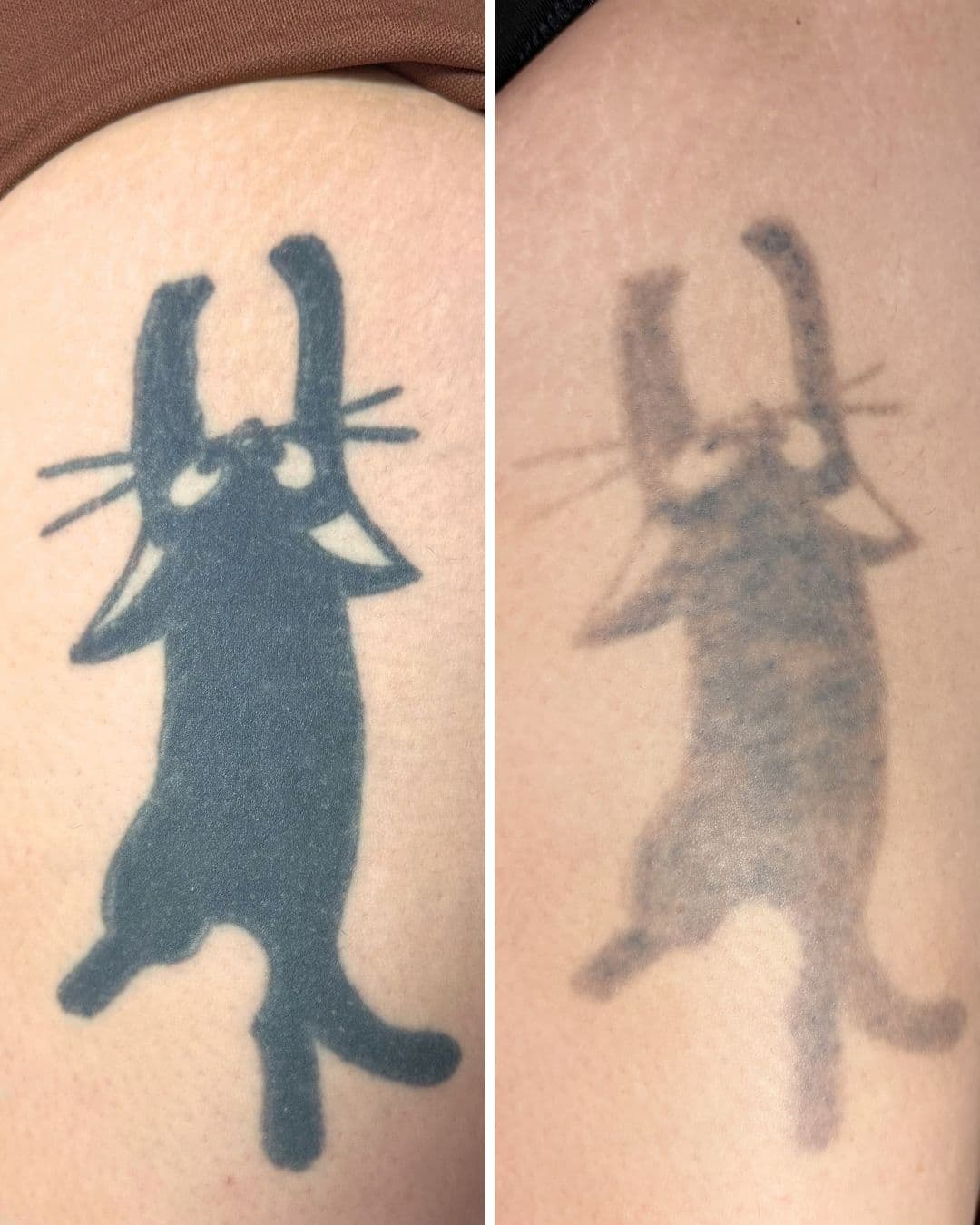
A solid black tattoo looks like one flat shape of pigment. Once laser tattoo removal starts, it rarely behaves like one. The cat in this photo shows it well: after six sessions with the PicoWay, the whiskers have thinned to faint grey threads and the outline has softened, but the body is still a mottled field of lighter and darker patches, with a few dark speckles still holding on near the top of the design.
That uneven middle stage surprises a lot of people, especially with a filled design. It is also completely normal, and it says more about how the tattoo was put in than about how the removal is going.
The fill was never as even as it looked
A solidly packed tattoo reads as uniform black from the outside because every area is dark enough to look the same. Underneath, it is anything but. The artist worked the fill in over many passes, so some spots took more pigment than others, some sit deeper in the skin, and some areas may have built up a little scar tissue from being worked repeatedly.
None of that shows while the tattoo is fully dark. It starts to show the moment the laser lifts the lighter areas and leaves the heavier ones behind.
"So we never see tattoos fade completely evenly," Billy DeCola, the founder of Studio Kiku, explained on the FADED Podcast. "And the reason why is because there are different saturation levels, there are different depths, there might be scar tissue in some areas where there isn’t scar tissue in other areas."
Why the whiskers went before the body
The thin lines on this cat carry far less pigment than the filled body does. A single line holds a narrow stripe of pigment, while the body is packed edge to edge. Each session breaks pigment into smaller particles for the body to clear, and a thin line simply has less to clear.
The same pattern shows up on almost every tattoo Studio Kiku treats, filled or not. Light work goes first. Dense work takes its time.
As Billy put it in an episode on real before and after results: "In tattoos, they don't fade evenly. Light shading normally goes first. The deeper, darker, more saturated areas tend to stick around a lot longer."
The darker clusters you can still see along the cat's back and near the top of its head are those saturated pockets. They are the parts of the original fill that took the most pigment, and they are what the coming sessions keep working on.
Where six sessions sits on the timeline
For a deep, saturated tattoo like this one, six sessions is roughly the middle of the process, not the end. Fading typically takes 3 to 6 sessions, and complete removal typically takes 9 to 12. Sessions are spaced at least 8 weeks apart, because the body keeps clearing broken-down pigment long after the visit is over.
The overall shape is still recognizable, but it has gone from a solid silhouette to a soft, translucent one, which is real progress even if it looks uneven up close.
The laser tattoo removal page covers the full process and what each stage tends to look like.
A mottled stage does not predict the final result
Uneven fading in the middle does not mean the darker spots will clear on schedule, and it does not mean they won't. Some saturated areas keep lifting steadily. Others slow down near the end and leave a faint shadow behind. Studio Kiku does not guarantee complete removal for exactly this reason, and the team will not tell you otherwise at a consultation.
Billy is direct about it: "Sometimes the fading stops, and there's still a faint shadow remaining."
Rushing does not even things out either. Turning the energy up to chase the dark pockets, or booking sessions closer together, puts more stress on the skin without speeding up how fast the body clears pigment. A tattoo with obvious scar tissue from the original work can also be slower in those areas no matter how carefully it is treated.
If you want to hear more of how Billy talks through the middle of the process, the episodes on the FADED Podcast walk through real tattoos at different session counts.
What this means for your own filled tattoo
If you have a blackout piece, a filled silhouette, tribal work or heavy shading, expect it to fade in patches rather than all at once. Expect the fine lines and lighter areas to drop away first, and expect the densest parts to need the most patience. A mottled look partway through is a sign the lighter pigment is clearing, not a sign that something has gone wrong.
For a long project like this, some clients prefer the Complete Removal Package, one flat rate that covers as many sessions as it takes. Individual sessions start at $100, and every tattoo is quoted on a case-by-case basis.
A filled tattoo is easier to plan around once someone has seen how densely it was packed and where the heavier pockets sit. Consultations are free, and the team can tell you what kind of timeline your piece is likely to follow before you commit to anything. Book a free consultation in Vancouver, Langley or Vaughan.
Thanks for reading.