
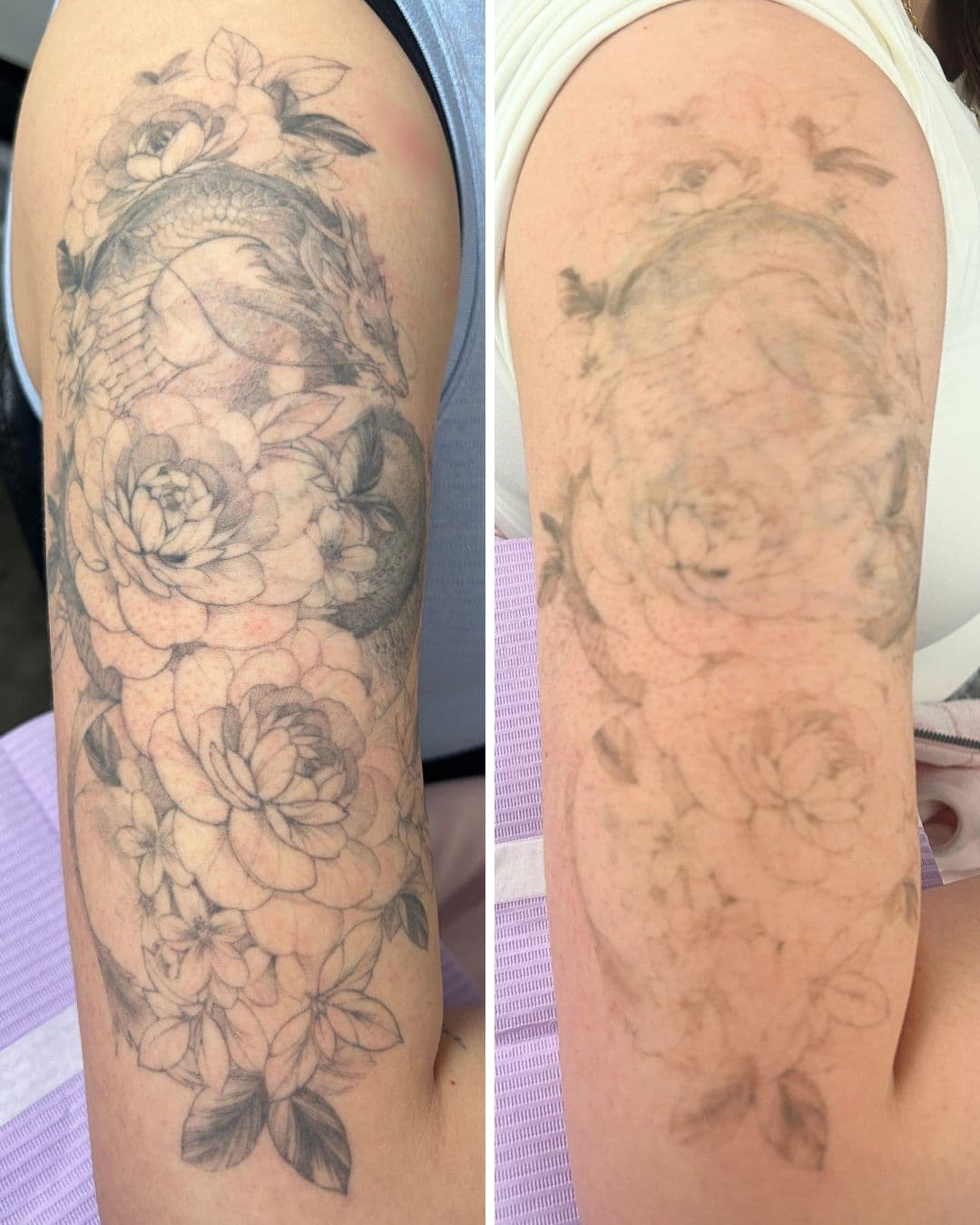
People with a large tattoo often assume they are signing up for the longest removal on the books. A piece that covers most of an upper arm looks like years of work before anyone has even touched it. The photo above is a useful correction to that assumption.
On the left is a black and grey design of peonies, small blossoms and leaves wrapped around a dragon, running from the shoulder almost to the elbow. On the right is the same arm after two sessions of laser tattoo removal on the PicoWay at Studio Kiku. Most of the shading has dropped back toward the skin tone, and the flowers now read as soft, broken outlines.
Size and session count are separate questions
The size of a tattoo decides how long each appointment takes and how much skin the laser has to cover. It does not decide how many appointments the removal needs. That number comes from what is inside the skin: how much pigment was packed in, how deep it sits, what kind of pigment it is, where it is on the body, and whether the original tattooing left scar tissue behind.
Billy DeCola, the founder of Studio Kiku, makes the point directly: "Just because a tattoo is small, it doesn't mean it's gonna take less sessions. A big tattoo that is less deep or the perfect type of pigment may take less sessions than a tiny tattoo that is super saturated and deep in the skin."
This arm is a good example of the first half of that sentence. The design is large, but much of it is soft, airy shading with bare skin showing between the petals. There is a lot of tattoo here, and relatively little pigment per square centimetre.
Reading the after photo closely
The fading is not even across the piece, and that unevenness is the most informative part of the photo. The pale shading inside the peonies and blossoms has almost disappeared. What is still clearly visible are the darker accents: the tips of the lower leaves, the small dark leaf near the top of the shoulder, and a grey band where the dragon's body was shaded more heavily.
That split follows the pigment load, not the drawing. "Sometimes wash comes out in a single session, maybe two. It's the darker, more saturated pigment like the black lines or the heavy black shading that takes a little bit longer to remove," Billy DeCola explains. A wash is black pigment diluted with water, and it is the kind of grey that gives way readily under a laser. The darker accents carry more pigment, so they have more to break up and more for the body to carry away.
The clearing itself happens between appointments. The laser fragments the pigment in a fraction of a second, and the lymphatic system then removes those particles over the following weeks and months. That is why sessions at Studio Kiku are spaced a minimum of 8 weeks apart, on a large piece exactly as on a small one. You can read more about how the studio approaches laser tattoo removal on the service page.
Two sessions is not where most dark tattoos are
This result is real, and it is also not typical for every tattoo. A dense, saturated piece often shows very little after one or two visits, and it can take two or three sessions before you notice a difference at all. Billy DeCola has talked through that slow start on the FADED Podcast: the laser breaks the pigment up quickly, and the body takes its time clearing it.
So a large tattoo with heavy black fill, solid lettering or tightly packed shading should not be measured against this arm. It may still respond well, but on its own schedule.
A bigger canvas means a bigger appointment
Large pieces carry trade-offs that a small tattoo does not. Pricing is based on the size of the tattoo, so a full upper arm costs more per session than something the size of a business card, even when the session count ends up modest. Laser tattoo removal at Studio Kiku starts at $100 per session, and every tattoo is quoted on a case-by-case basis.
A large area also means more treated skin to look after in the weeks after a session: keeping it out of the sun, keeping it cool, and leaving it alone. Some greys in black and grey work are made by mixing black with white rather than thinning it with water, and white does not clear with laser. Those areas can stay behind even when the rest of a piece fades well, which is one reason complete clearance is never promised.
For people planning full removal of a large tattoo, the Complete Removal Package is one flat rate covering as many sessions as the tattoo takes, so the total is known before the first appointment rather than added up visit by visit.
Bringing a large piece in
A consultation is the place to find out which kind of large tattoo you have: the airy kind that moves early, or the dense kind that takes its time. Consultations are free, and the team can look at the shading, the darker accents and any grey that might contain white before a single pulse is fired. Book a free consultation at the Vancouver, Langley or Vaughan studio and bring the whole piece, shoulder to elbow.
Thanks for reading.