
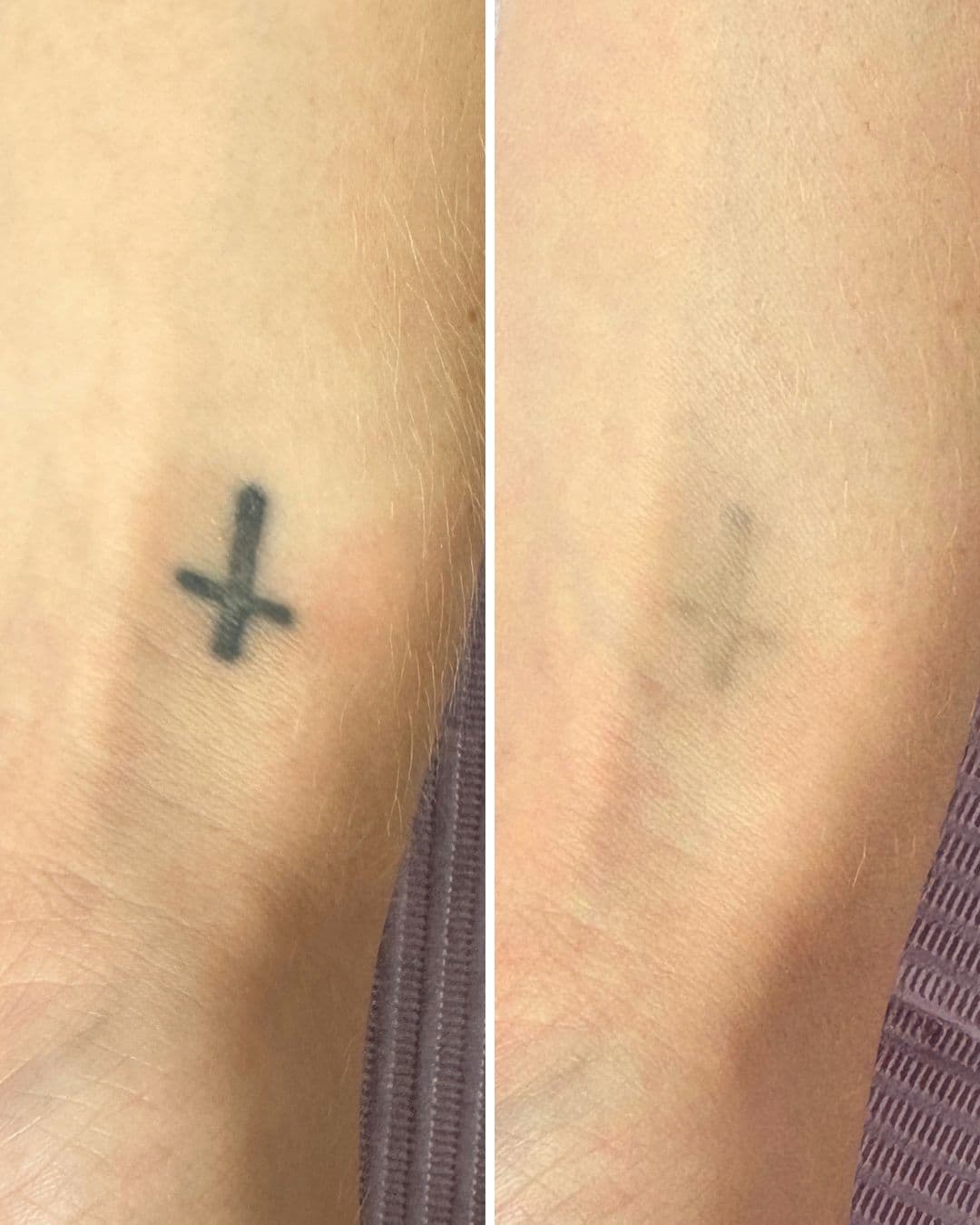
The cross in the photo above is about the size of a thumbnail. It has lightened, the edges have gone soft, and it still has several sessions ahead of it, because the pigment underneath it was packed in heavily and placed deep. Most people who book a consultation for a tattoo this size walk in expecting one visit, possibly two.
Size is the first thing anyone judges a tattoo by, and it is close to useless as a predictor of how long removal will take. A small tattoo can hold more pigment per square centimetre than a large one, and the laser is working on the pigment, not on the outline.
What a small tattoo can be hiding
Two things decide most of the session count: how much pigment is sitting in the skin, and how deep it was placed. Soft black and grey shading across a forearm can be thinner in both senses than a tiny solid symbol that an artist packed hard, or that someone's friend tattooed at a kitchen table with no control over depth. The area being treated is smaller. The work per square centimetre is not.
Billy DeCola, the founder of Studio Kiku, puts it this way on the Faded Podcast: "And here's one that often surprises people. Just because a tattoo is small, it doesn't mean it's gonna take less sessions. A big tattoo that is less deep or the perfect type of pigment may take less sessions than a tiny tattoo that is super saturated and deep in the skin."
The pigment in that cross is a good example. It reads as a simple shape, and it behaves like a dense one.
Where it sits changes the pace
Placement does more to the timeline than size does. Pigment leaves through the lymphatic system, and some parts of the body move lymph far better than others.
"Number three is the location on your body," Billy explains. "Your torso, your shoulders, your thighs, those body parts have a lot more lymph flowing through them than let's say your fingers, your feet, your ankles, those have a lot less. The more close to your heart, I would say, the quicker the tattoo is gonna fade."
This is why a small finger or ankle piece often moves slower than a larger tattoo on a thigh. The tattoo that looks like a quick job is sitting in the part of the body least equipped to carry pigment away.
The wait between sessions is the same either way
Laser tattoo removal sessions are spaced a minimum of 8 weeks apart at every Studio Kiku location, and that spacing has nothing to do with how big the tattoo is. The laser fragments the pigment in one pass. Clearing those fragments is the body's job, and it takes weeks regardless of whether the treated area is a cross on a wrist or a half sleeve.
So a small tattoo is not a short project. Removing one still means planning around a series of appointments spread across months, which is worth knowing before the first one is booked rather than after.
What the early sessions look like on a small piece
Removal takes time, and it can take two or three sessions before a visible difference shows up. Real fading usually gets going somewhere around the third to sixth session.
On a small tattoo that stage is harder to read, because there is less area to compare against. A thumbnail-sized shape that has gone from solid black to soft grey has changed enormously, and from a phone photo taken in different light it can look like nothing happened. Photographing the tattoo in the same spot and the same light before each visit is the most useful thing a client can do for their own peace of mind.
What this does to the quote
Pricing follows the same logic. Laser tattoo removal at Studio Kiku starts at $100 per session, and every tattoo is quoted case by case after a technician has looked at it, because two tattoos of identical size can need very different amounts of work. For clients who would rather know the full cost up front, the Complete Removal Package is one flat rate covering as many sessions as the removal takes.
Nobody at the studio can give a real number from a description over the phone. Billy says the same thing on camera: he cannot answer it properly without seeing the tattoo.
The shadow a deep little tattoo can leave
Complete clearance is never promised on any tattoo, and a small, heavily saturated one is not exempt from that. Pigment placed very deep, pigment of unknown composition, and scar tissue left behind by the original tattooing can all stop a removal short of bare skin, and a faint shadow can remain where a dense little shape used to be.
The answer to that is not a stronger setting. Pushing the laser to force a stubborn tattoo out faster is how skin gets damaged, and a scar in the shape of the tattoo is a worse outcome than a faint mark. A technician will say during the consultation when a tattoo looks likely to hold something back. Billy covers the same ground in detail on The Faded Podcast.
Getting a number for your own tattoo
If you have a small piece you want gone and you have been assuming it is a one-visit job, a consultation will tell you what you are actually looking at. Consultations at Studio Kiku are free, and a technician will read the saturation, the depth and the placement in person before giving you a session range and a price. Book a free consultation in Vancouver, Langley or Vaughan.
Thanks for reading.