
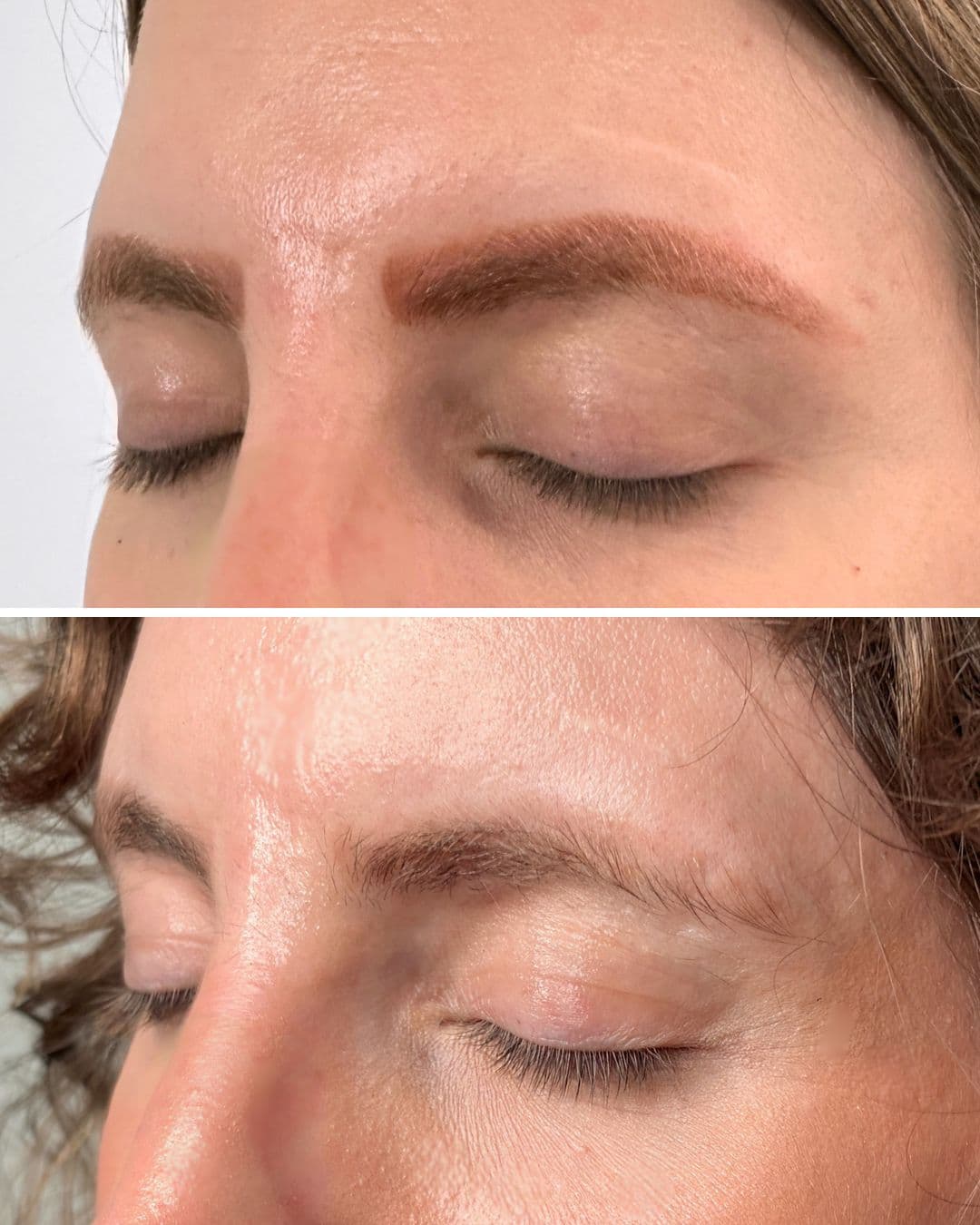
You're four sessions into brow removal. Most of the pigment is gone, the shape has softened, and what's left is a faint warm trace that didn't move much this time. Then you start reading, and half of what you find tells you to try saline. Some of it tells you to start with saline and finish with laser.
Studio Kiku works in the opposite order, and the order isn't a preference. It's the sequence that protects the skin you're trying to get back.
What four sessions of brow removal usually look like
PMU pigment comes out in layers, not all at once. The dark surface colour lifts first, which is why brows often look dramatically lighter early on. Underneath it sits the undertone the manufacturer blended in so the brows would settle warm, usually red, sometimes yellow, occasionally with white mixed through. When the dark clears, that undertone becomes the new surface.
Complete brow removal averages three to six sessions, spaced at least eight weeks apart, and the last stretch is always slower than the first. A faint trace after four sessions isn't a stalled case by itself. It's the point where the technician has to work out whether the remaining pigment is still moving, just slowly, or whether it has stopped.
That distinction is the whole decision. Pigment that's still responding doesn't need saline. Pigment that has genuinely stopped is a different conversation.
The order Studio Kiku works in
Laser PMU removal comes first in every case, including the cases where the client arrives already asking for saline.
"A lot of people want to jump right into saline before they try the laser. And honestly, saline is, in my opinion, the very last resort," says Billy DeCola, Studio Kiku founder. "Saline can be very effective in some situations, but it's definitely not my first choice in the toolbox."
The practical argument for going laser first is that it costs you almost nothing to find out. The PicoWay breaks the pigment into fragments and the lymphatic system carries them away over the following weeks. The skin isn't opened, so a session that turns out to be unproductive leaves you no worse off than before. Even a single test spot answers the question of whether the pigment responds at all.
Why starting with saline makes the rest harder
The advice to soften pigment with saline first and laser it after comes almost entirely from people who perform saline. Billy DeCola is direct about it:
I would not start with saline removal and then try to do laser. A lot of people out there, and these are the people who are doing saline, they promote it that way, where they say, give saline a try, break down that pigment and bring it to the surface, and then try laser. I think that's completely wrong.
Two things go wrong when the order is reversed. The first is that saline opens the skin, and an open brow carries real risk: scabbing, infection, a change in skin texture, and where there's hair, the chance of losing some of it to scarring. A scar in the brow doesn't fade on a schedule the way pigment does.
The second is that you lose your ability to read the result. Freshly worked skin is irritated, and irritation hides warm tones particularly well. You can walk out convinced the yellow is gone and watch it reappear a month later once the skin has settled and healed. Starting with the method that can't tell you what it did, before trying the method that can, means guessing twice.
When saline does become the right call
Saline earns its place at a specific moment: after the laser has taken the pigment as far down as it will go and the fading has flattened out. Usually that means a stubborn warm undertone, and most often it means yellow, which is the hardest colour in permanent makeup and in many cases can't be removed at all.
At that point there isn't another tool. Saline removal uses a needle and a saline solution worked into the pigment layer rather than light energy, so it isn't bound by which wavelength a colour absorbs. Sessions are spaced eight to twelve weeks apart, because the skin is being opened each time and needs the gap. Billy covers the full reasoning on The Faded Podcast, including what he tells clients who arrive asking to skip the laser entirely.
What saline asks of your skin
Saline is not a tidier version of laser, and anyone considering it should know what the weeks afterward involve. The area scabs. It needs open-wound care, and picking at the scab interferes with the lifting. The result can't be judged until the skin has completely healed and the irritation is gone, which takes considerably longer than a laser session's recovery.
It also doesn't always work. Some pigment lifts well with saline and some doesn't move at all, and nobody can tell you in advance which one you have. That's not a reason to rule it out when the laser has finished its work. It is a reason not to reach for it first.
If your brows have gone quiet after a few laser sessions and you're trying to work out whether to keep going or change methods, that question is answerable in person and almost impossible to answer from photos. A consultation at Studio Kiku is free, and the technician can tell you which colour is actually left in the skin and what each option realistically does with it. Book a free consultation in Vancouver, Langley, or Vaughan.
Thanks for reading.