
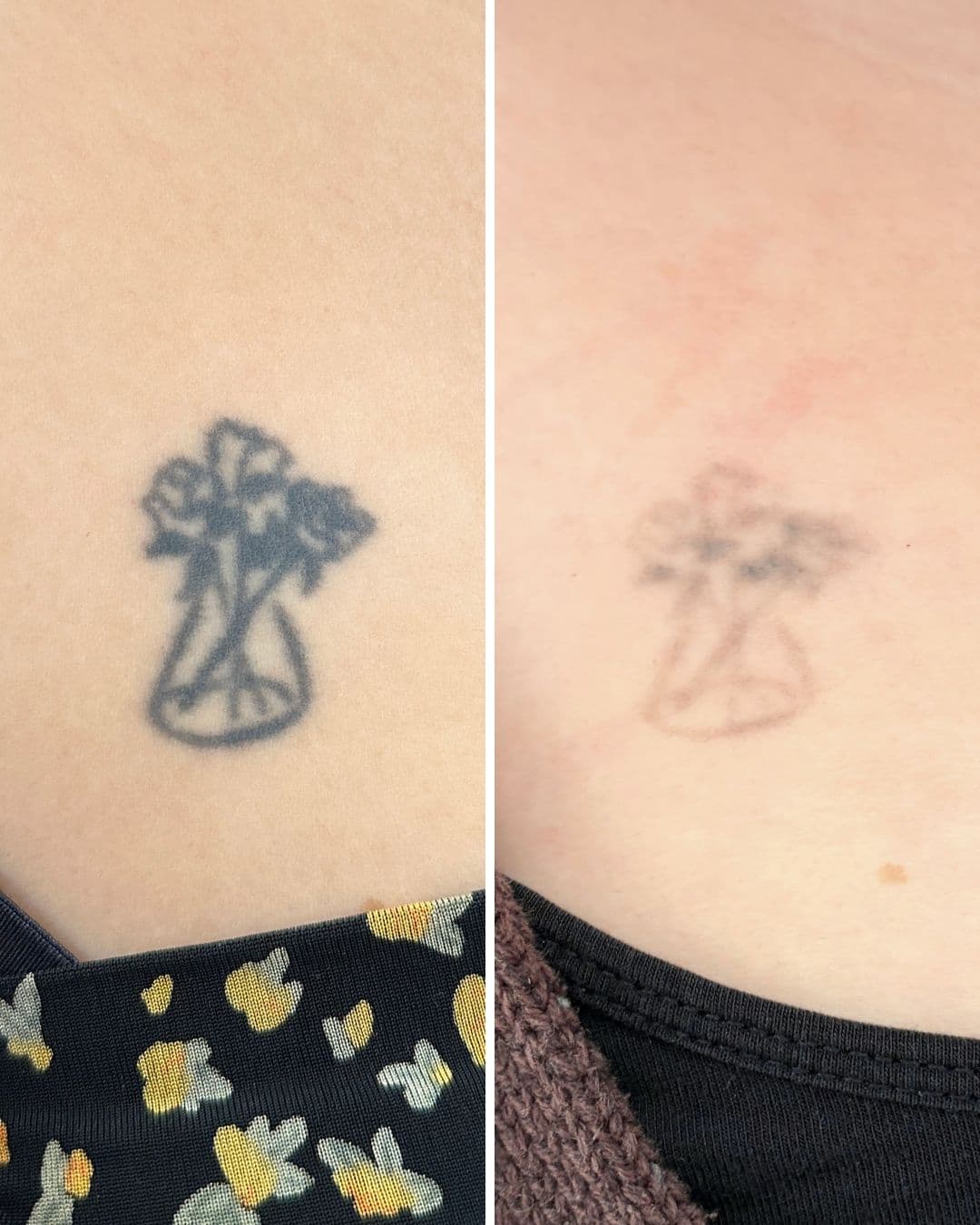
A tattoo in the middle of the chest sits right where a neckline falls, so it shows up in almost every shirt you own. If you've been thinking about chest tattoo removal, the photo above is a useful reference point: a small black flower-and-vase design, photographed before treatment and again after four sessions on the PicoWay.
On the left, the lines are solid and the petals are filled dark. On the right, the vase has softened into a pale trace, and the flowers read as a loose grey smudge rather than a drawing. The tattoo isn't gone, and nobody at Studio Kiku would call it finished. What the photo shows is the stage where the fading has clearly taken hold.
Why the chest tends to respond well
The laser's job is fast. Each pulse shatters the pigment into particles small enough for the body to carry away. The slow part is the carrying, which is handled by the lymphatic system, and the amount of lymph moving through a body part changes how quickly it clears.
"Your torso, your shoulders, your thighs, those body parts have a lot more lymph flowing through them than let's say your fingers, your feet, your ankles, those have a lot less," says Billy DeCola, Studio Kiku founder. "The more close to your heart, I would say, the quicker the tattoo is gonna fade."
The chest is about as close to the heart as a tattoo gets. That doesn't make it fast in any absolute sense, but it does mean a chest piece usually isn't fighting the same uphill battle as a script tattoo on a finger or a design on the top of a foot.
How the session itself feels on the chest
Comfort is a fair question for this spot, since the skin over the sternum is thin. Billy's rule of thumb is that areas where you're ticklish tend to be more sensitive, and he places the chest among the easier areas, alongside the forearm and shoulder, rather than with the ribs, the inner thigh, or under the arms. Every person is different, and the team cools the skin before and during treatment so you can settle in. You can ask for a break at any point.
What changes between session one and session four
Most people don't see much after the first session, and sometimes not after the second either. The laser has done its work, but the body is still clearing the fragments. It can take 2 to 3 sessions before you notice a real difference, and then the fading tends to pick up.
You can see that pattern in this photo. The outline of the vase has lightened more than the flowers have. The petals were packed with more pigment, and the more saturated parts of any tattoo are the ones that hang on longest. Lines and fill rarely fade at the same rate, so an uneven look partway through is normal rather than a sign that something has stalled.
The spacing matters here as well. Studio Kiku schedules sessions at least 8 weeks apart, because the clearing carries on long after you leave the chair. Billy's own words on this are plain: coming in more often doesn't mean the tattoo will fade quicker. At that spacing, four sessions add up to the better part of six months.
Four sessions is a checkpoint, not the finish
Fading for a cover-up typically takes 3 to 6 sessions, so a result like this one may already be enough if a new design is going over the top. Complete removal is a longer road, usually 9 to 12 sessions, and Studio Kiku doesn't guarantee that every trace will clear. Depth, saturation, the age of the tattoo, any scar tissue from when it was applied, and your own health all play a part, and two chest tattoos that look alike can still move at different speeds.
It's also worth knowing what this photo can't promise. A fine, lightly packed tattoo will often fade faster than this one; a dense, heavily saturated piece will usually need more visits. The chest gives you a good starting position, not a timeline.
Choosing between per-session and full removal
If the goal is to see the skin clear rather than to prepare it for new work, the session count is where planning starts. Laser tattoo removal at Studio Kiku starts at $100 per session, and the Complete Removal Package is one flat rate that covers as many sessions as it takes. Clients who already know they want the chest piece gone completely often find the package simpler to plan around than paying visit by visit. You can read more about the treatment itself on the laser tattoo removal page, or about the PicoWay, the picosecond laser used on this chest piece.
A chest tattoo is easy to judge in person and hard to judge from a phone photo, since lighting flattens how dense the fill really is. Bring the tattoo to a free consultation in Vancouver, Langley, or Vaughan, and the team can tell you how it is likely to behave and whether fading or full removal fits what you want. Book a free consultation whenever you're ready.
Thanks for reading.