
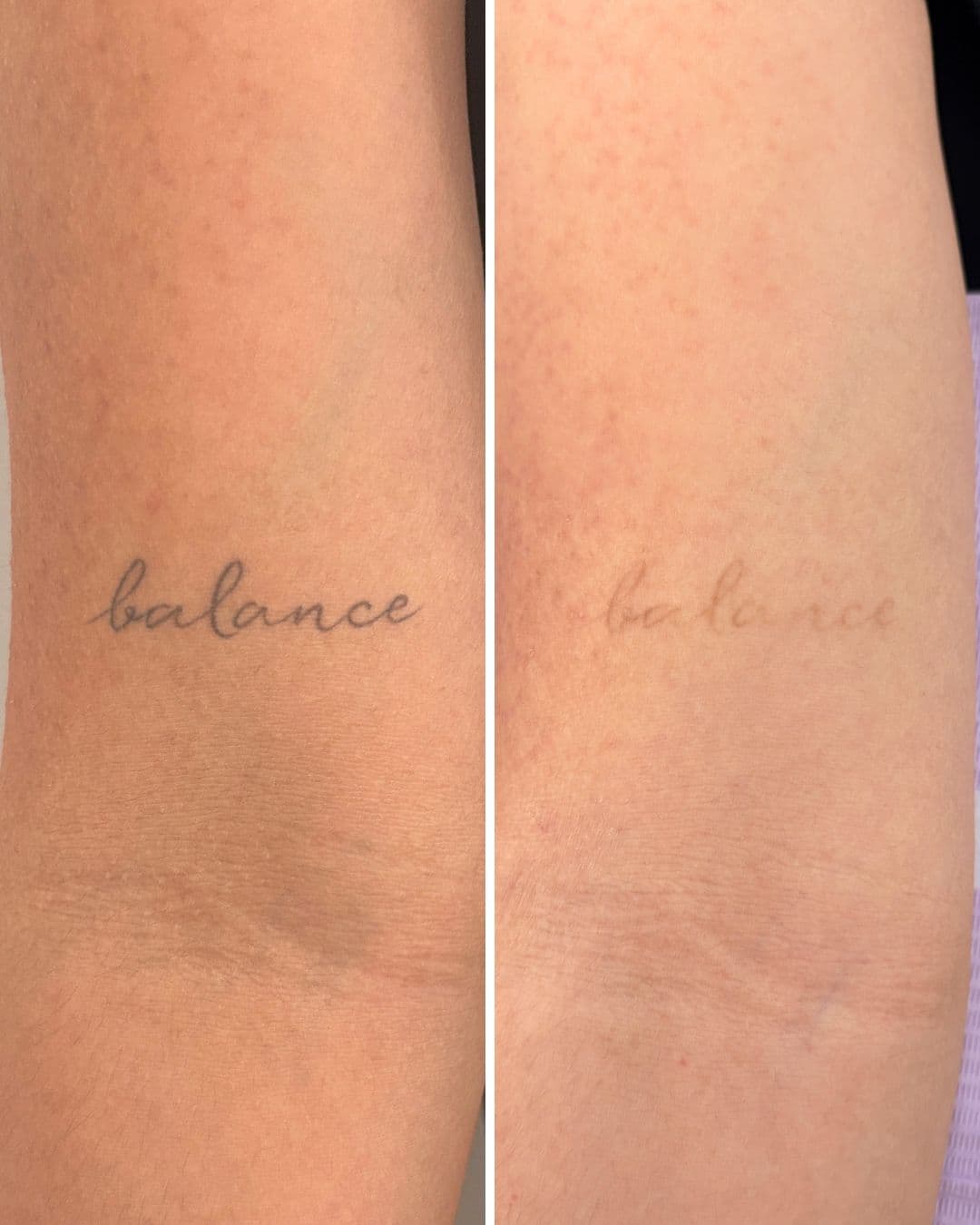
The word in the after frame of this photo is close to gone, and you can still read it. That is the part most people with a script tattoo do not expect. Thin lettering loses its weight early in laser removal, so the strokes go pale and patchy while the shape of the word holds on longer than the pigment does.
Studio Kiku treats a lot of lettering: single words, names, dates, a line of cursive on a wrist or an inner forearm. The pigment behaves the way pigment always behaves. What changes is how you read the progress, because a familiar word stays recognisable at a stage where a picture would already look like nothing.
What one pass does to a thin stroke
Laser tattoo removal works by fragmenting pigment rather than lifting it out. The laser delivers pulses that the pigment absorbs, the pigment breaks into particles small enough for the lymphatic system to carry away, and the body does that clearing over the weeks between appointments. Studio Kiku runs this on the PicoWay, a picosecond platform, so each pulse lands in a trillionth of a second and works on the pigment while sparing the tissue around it.
On a solid black fill you watch a block lighten. On a hairline stroke you watch the line come apart. Compare the two frames above: the before letters are a continuous, even grey with clean edges, and the after letters are thinner, blotchy, and broken up, lighter in some spots than others because some pigment clusters have already cleared and their neighbours have not. The skin between and around the strokes reads as skin.
That uneven look is normal at this stage, and it is one reason mid-treatment photos of lettering can be discouraging when the fade is actually going well.
Why a word keeps reading after the pigment thins
A word does not need much pigment left to stay legible. You already know what it says, your eye has gone to that same patch of skin for years, and letters carry meaning from their outline alone. A drawing needs contrast to look like anything. A word only needs enough of a trace for your brain to finish it.
This is why the goal of a script removal is worth naming out loud at the consultation. Someone who wants the area clear enough to tattoo over is finished far earlier than someone who wants to stop seeing the word in the mirror. Both are reasonable goals. They are not the same number of sessions.
What the session range looks like for lettering
Studio Kiku quotes 3 to 6 sessions for significant fading and 9 to 12 for complete removal of a dark, saturated tattoo, with sessions spaced a minimum of 8 weeks apart. A thin single-pass word usually carries less total pigment than a filled or shaded piece of the same size, so it tends to sit at the lighter end of that range. Depth matters as much as volume, though. Hand-poked or shallowly applied script often sits at an inconsistent depth along the same word, which is how one half of a phrase clears ahead of the other.
"We never guarantee complete removal, but what we do promise is that we'll continue to treat it until we reach the point where it's completely gone, or your body decided that it's not able to break it down anymore," says Billy DeCola, Studio Kiku founder.
That is also what the Complete Removal Package covers: one flat rate for as many sessions as the removal takes, rather than a session count decided in advance.
Size does not shorten the calendar
A small word takes very little time in the chair. It does not take less time on the calendar. The 8 week minimum between sessions exists because the body needs that long to clear the pigment the last session broke, and the body works at its own pace regardless of how many square centimetres were treated.
So a two inch word and a full sleeve follow the same spacing. Coming back sooner adds discomfort to the area without adding fade, because there is nothing new for the laser to do until the previous round of fragments has moved.
The last faint trace is not always worth chasing
Some tattoos stop responding before they clear completely. Scar tissue from the original tattooing can hold pigment in place, and white or very light pigments, sometimes used to brighten a script or shade around it, may not clear at all. Pigment and texture changes in the skin are also possible outcomes of any laser treatment.
Billy DeCola is direct about the one thing nobody can measure in advance. "We know that the laser works. We know the pigment's going to break," he says. "But, we do not know if your body is capable of picking up those pigment particles."
The practical version of that: when a word is faint and the skin is intact, pushing the settings harder to force out the last legible trace is a poor trade. Studio Kiku would rather stop at a plateau with the skin intact than push for a clearance the skin pays for. A faint shadow you have to look for is a better outcome than a mark in the exact shape of the letters.
If there is a word on you that you have stopped agreeing with, bring it in. A consultation at Studio Kiku is free, and it covers what that specific lettering is likely to do, how far it needs to fade for what you want next, and what the spacing will mean for your calendar. Book a free consultation in Vancouver, Langley, or Vaughan and you will get that read before anything is treated.
Thanks for reading.