
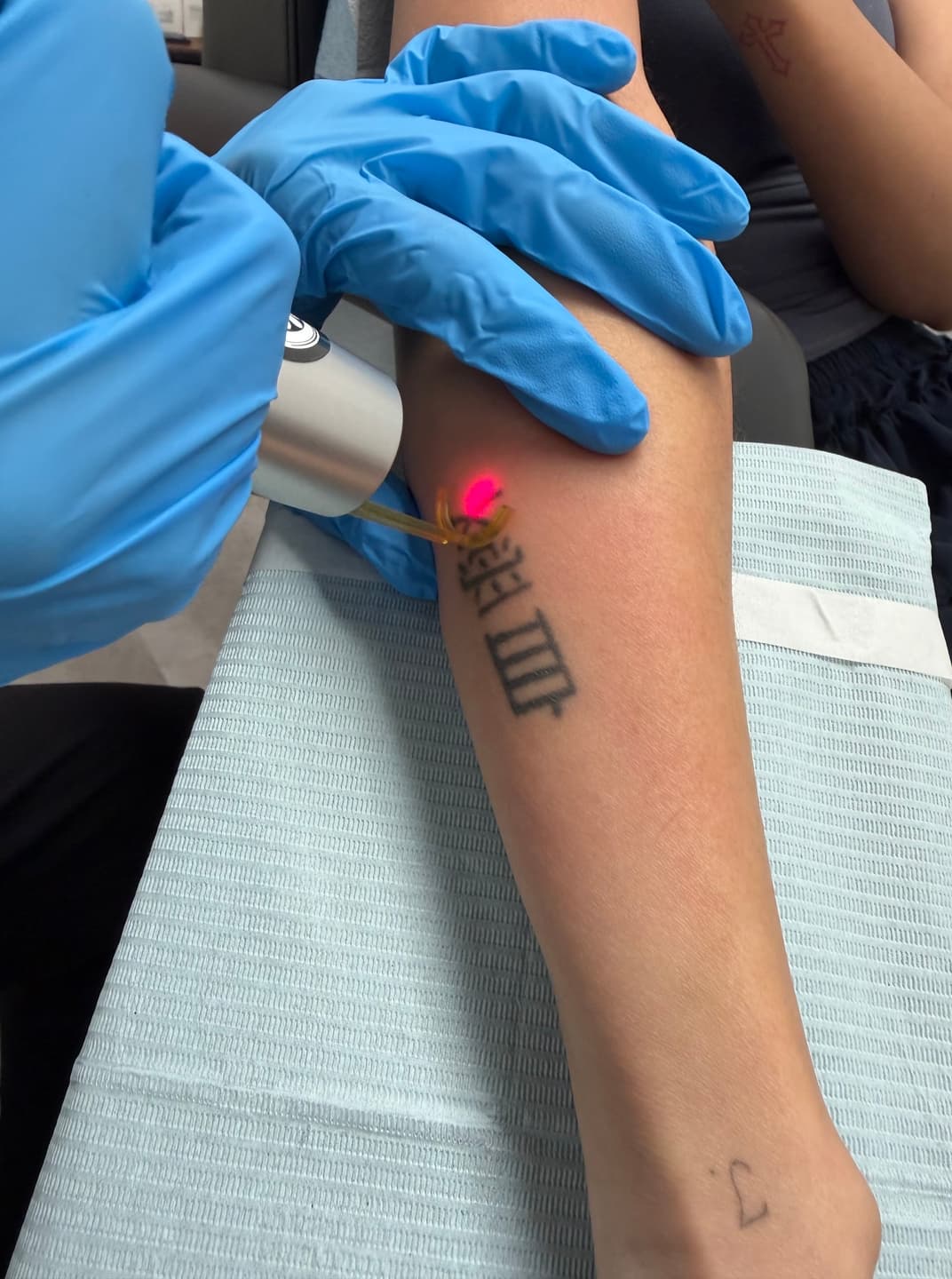
Most people ask about pain before they book anything. Laser tattoo removal does sting, and the question deserves a clear answer before you commit to starting.
Most clients describe it as a sharp, hot snap against the skin, like a rubber band released close to the surface. The sensation is brief because each pulse lasts a fraction of a second. How much it accumulates over a session depends on the size of the tattoo, its location on the body, and how you showed up.
What the sensation is actually like
The PicoWay laser delivers pulses in the picosecond range, meaning each pulse lasts one trillionth of a second. That speed matters for comfort: shorter pulses transfer less heat to the surrounding tissue, which is why the PicoWay tends to be more tolerable than older nanosecond devices for most clients.
What you feel is a sharp snap on each pulse. For small tattoos, a session is over quickly and the discomfort doesn't build much. For larger, more saturated work, the passes take longer and the sensation accumulates. The laser also makes a small click on each pulse, which helps some clients anticipate the rhythm and stay relaxed.
How Studio Kiku reduces discomfort during treatment
Every session at Studio Kiku is delivered alongside the Zimmer Cryo 6, a cooling device that blows chilled air onto the treatment area before, during, and after each laser pass. The cooling reduces the burning quality of the sensation significantly and helps manage any immediate swelling.
Before starting, the technician performs a test spot and explains what the client will feel. Clients can ask for a pause or a break at any point during the session. The session is meant to be effective, and a client who can stay relaxed and still throughout gets better results than one who is tense the entire time.
Using numbing cream and how to do it right
Numbing cream is available in studio, and clients can also apply it before arriving. The timing is what most people get wrong. Billy DeCola, Studio Kiku founder, explains: "Put it on about a half hour before you come in. 15 minutes is not enough and an hour, hour and a half is way too long. You wanna be around 30 minutes, that's the sweet spot."
What makes a session feel worse
Skin condition and body temperature going into the appointment both affect how much you'll feel.
"If you come in with a sunburn or your skin is irritated in any way, you're definitely gonna feel the laser a lot more than if you didn't do that," says Billy DeCola. "So take care of your skin before you come in. Don't get any sun exposure whatsoever on the treatment area."
Billy's advice for the day of the appointment: "Have your body temperature nice and cool if you can when you come in and have an ice pack ready when you go home."
Heavily saturated tattoos and cover-ups also take more passes per session, which means more cumulative sensation. The laser tattoo removal process for dense, layered work differs from treating a lighter original tattoo, and it's worth knowing that going in.
The spots where sessions are hardest to sit through
Body placement makes a real difference. Areas where the skin sits close to bone, including the ribs, hands, fingers, the spine, and ankles, tend to be more intense than areas with more soft tissue underneath, such as the upper arm or thigh.
Hands and fingers are particularly difficult because of the concentration of nerve endings. That's part of why finger tattoos require more care throughout treatment: the skin is reactive and responds differently than skin on the body's core.
For sensitive placements, arriving well-prepared matters more than it does for a less sensitive area. Correct numbing cream application, no sun exposure in the weeks before, and coming in with a cool body temperature make the biggest combined difference.
Placement doesn't change how many sessions you'll need. A wrist tattoo and a shoulder tattoo of equal size and saturation require the same number of sessions. The location affects comfort, not the outcome.
The laser tattoo removal aftercare guide covers everything to do in the first 24 hours after a session, alongside guidance for the full period between appointments.
If pain is what's been keeping you from booking, bring that question to a consultation. Studio Kiku will look at your specific tattoo, walk through what the sessions would feel like for that location and saturation, and set clear expectations for the full process. Book a free consultation in Vancouver, Langley, or Vaughan.
Thanks for reading.