
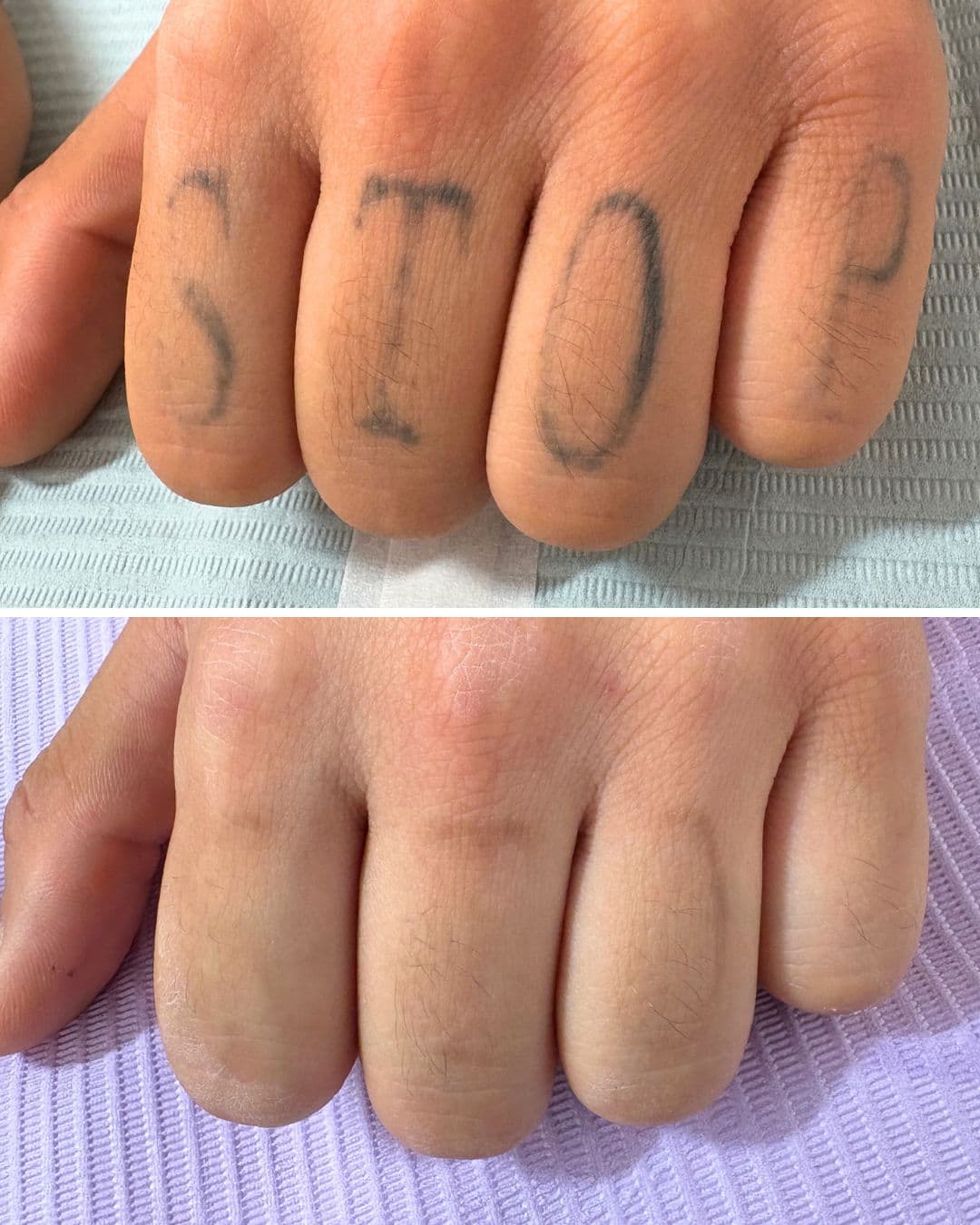
Blown-out tattoos are one of the more common concerns clients bring to Studio Kiku. The edges are blurry, the lines have spread, and the tattoo looks diffuse in the skin rather than clean and defined. Laser removal can address this, but the process and the realistic outcome are a little different from removing a crisp, sharply placed tattoo.
Understanding what blowout actually is, and how the laser interacts with spread pigment, helps set the right expectations before treatment starts.
What a blown-out tattoo is
Blowout happens when pigment is placed too deep in the skin, or migrates beyond the layer where it was originally deposited. Instead of sitting in a defined zone, the pigment spreads outward through the surrounding tissue. The result at the surface is a tattoo with edges that look soft, blurry, or shadowed, as if the design has leaked slightly into the skin around it.
It is particularly common on high-movement areas of the body. Knuckles and finger joints are among the most frequent cases Studio Kiku sees. Thin skin sitting directly over bone, combined with constant flexion throughout the day, makes precise pigment placement harder during tattooing. Even well-applied work on the knuckles can show some degree of blowout over time as the skin moves and the pigment shifts.
How laser removal works on spread pigment
The laser targets pigment regardless of where it sits in the skin. Studio Kiku uses the PicoWay by Candela Medical, which delivers extremely short pulses of energy that cause the pigment to fragment into particles small enough for the lymphatic system to carry away. A blown-out tattoo has pigment spread across a wider area, but the clearing process works the same way.
The practical difference is the total volume of pigment involved. A tight, well-defined tattoo has its pigment concentrated in a narrow zone. A blown-out tattoo has pigment spread outward from that zone, which means the laser needs to address a larger area, and the body needs to clear more particles across more sessions. Laser tattoo removal on blown-out work typically falls into the longer end of the expected session range rather than the shorter end.
Why deep placement affects the session count
Tattoo depth matters because lymphatic drainage is how the body clears the shattered pigment. Pigment placed close to the surface is more accessible to the lymphatic system and clears more readily between sessions. Pigment placed deeply, or that has migrated deeper over time, takes longer to reach.
This is one of the reasons Studio Kiku spaces sessions a minimum of 8 weeks apart. That gap gives the body time to complete as much clearance as possible before the next treatment. When pigment is sitting deep or spread across a wide zone, respecting that window becomes even more important.
The approach at Studio Kiku: conservative settings, gradual progress
Deeply saturated and blown-out tattoos require a measured approach throughout the entire removal process. Aggressive settings early on create a different problem: scarring. Billy DeCola, Studio Kiku founder, explains it directly: "When you see a very saturated, dark tattoo, it's important to go slowly from the beginning. If you laser it so aggressively, you're going to remove the pigment, but you're going to leave a scar in the same shape of the tattoo that you had."
The protocol at Studio Kiku starts at conservative settings in the early sessions, increases gradually as the pigment fades, and never sacrifices skin integrity for speed. The knuckle case shown above reached significant fading after five sessions without any damage to the skin. That result is the goal: no rush, safe removal.
The blur fades but never sharpens
Laser removal on a blown-out tattoo can clear a significant amount of pigment and dramatically improve how the area looks. What it cannot do is restore crisp, defined lines where the blowout has already spread the pigment outward. The blurry edges do not sharpen during removal. The spread pigment fades along with everything else, leaving cleaner skin but not a redesigned tattoo.
For clients who want the pigment gone, significant fading and full removal are realistic goals given enough sessions. For clients hoping laser will tighten diffuse edges and produce a sharper design in the end, that is not how the process works. Studio Kiku is straightforward about this at the consultation, so every client goes in with a clear picture of what the outcome will look like.
A blowout is impossible to assess from a photo, so the process starts with a free consultation. The technician examines how deep and how far the pigment has spread, and tells you straight what removal can and cannot do for your piece. The Complete Removal Package is also worth asking about: it covers as many sessions as needed for a single flat rate, which simplifies the commitment when the session count is harder to predict from the start. Book a free consultation in Vancouver, Langley, or Vaughan.
Thanks for reading.