
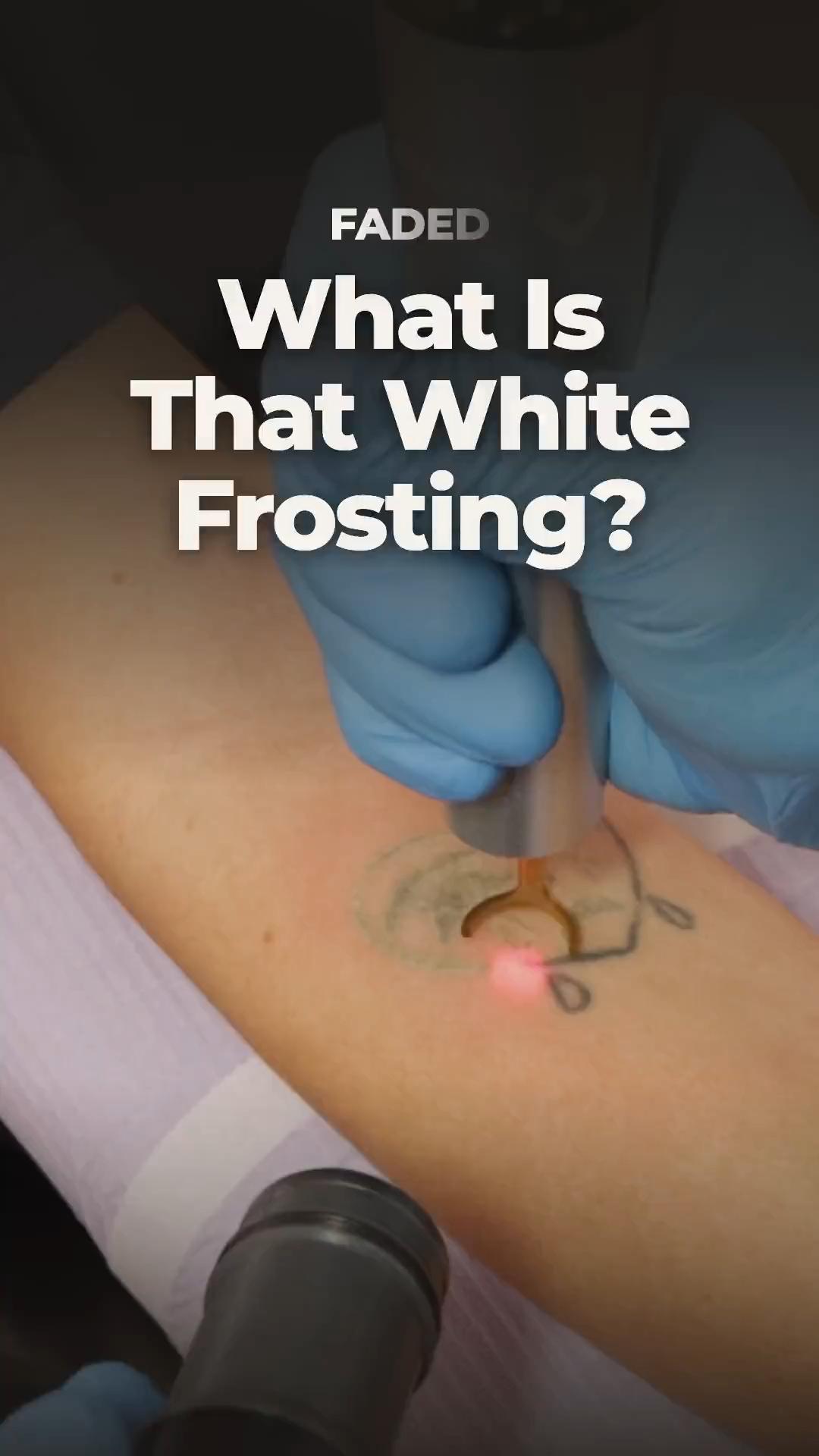
The first pass of the laser surprises almost everyone. A tattoo that was dark a second ago turns chalky white wherever the handpiece touches it, and for a few minutes it looks as if the design has vanished. That white layer is called frosting, and it is one of the most common things clients ask about during laser tattoo removal.
Frosting is real and it means something, but it is not the result. Knowing the difference saves you from reading too much into one session, good or bad.
Where the white comes from
Laser tattoo removal works by delivering very short pulses of energy that shatter pigment particles in the skin. When those particles break apart, they release a small amount of gas. That gas rises toward the surface and briefly turns the treated area white and cloudy.
So frosting is a sign that the pulse reached the pigment and did its job of breaking it up. On the PicoWay, which Studio Kiku uses at every location, the pulse is measured in picoseconds, and the white appears the instant it lands.
Why the tattoo comes back after a few minutes
The frost usually settles within 10 to 20 minutes. Once it does, most body tattoos look much the same as they did when you walked in. That can feel deflating if you expected the white to be the fade itself.
Billy DeCola, the founder of Studio Kiku, put it plainly on an episode of the FADED Podcast: "Just because it frosts, it doesn't mean the tattoo is disappearing. Usually after 10 to 20 minutes, the frost disappears and the tattoo will look exactly like it did when you walked in the studio."
The shattered particles are still sitting in the skin at that point. Your body clears them gradually through the lymphatic system, and that process takes weeks to months. The real change shows up between sessions, not in the chair.
There is one exception worth knowing. When the pigment sits very close to the surface, as it does in permanent makeup and some very fine-line tattoos, it can sometimes disappear right after the frost. That is the shallow placement at work, and it doesn't happen every time.
Why later sessions frost less
In the first few sessions, and on heavily saturated pigment, a lot of frosting is normal. There is simply a lot of pigment for each pulse to hit. As the tattoo lightens over several sessions, the frost gets thinner, and eventually there may be almost none.
Less frosting at that stage does not mean the laser has stopped working. It usually means there is less pigment left to react. Clients sometimes worry that a quiet session was a wasted one, and that is rarely the case.
Frosting is not a scorecard
It is tempting to treat a bright white frost as proof of a strong session. The opposite reading is also common: a faint frost must mean little happened. Neither holds up.
"Sometimes when we get less frosting, we still get great results. Other times we'll get a lot of frosting and we won't get good results," Billy DeCola explained in an episode devoted to frosting. Frosting is one of the signs a technician watches for during treatment, but it doesn't predict how much a tattoo will fade. What moves a tattoo forward is consistent treatment, with sessions spaced at least 8 weeks apart so the body has time to clear what was broken up.
White pigment is a good example of why the frost can mislead. White mixed into a grey wash can frost strongly and look as if something dramatic is happening, while the pigment itself barely responds or even darkens slightly.
When there is too much of it
Frosting is a useful signal, but more is not better. A very heavy frost in the early sessions can mean the area is being overtreated, which builds up too much heat under the skin. Excess heat is what leads to blistering, and blistering raises the risk of scarring and of pigment changes in the skin.
That is why a careful technician adjusts the energy as the frost appears. At Studio Kiku, the aim is a clear, even frost without pushing past it, and the laser is turned down when the skin is reacting more than it should. A session that frosts dramatically is not a sign the studio is working harder for you. It can be a sign that someone is trading safety for a faster-looking result, and that trade rarely pays off.
If you have had removal elsewhere and the area blistered badly after a session that turned very white, mention it at your consultation. Previous treatment changes how a tattoo should be approached.
Seeing it for yourself
The frost is easiest to understand once you watch it happen, which is why the FADED Podcast gave it a full episode. You can find that episode and many others on the FADED Podcast page, where Billy explains other parts of laser tattoo removal in his own words.
If you are curious how your own tattoo would respond, a consultation is free and there is nothing to commit to. The team can explain what you'll see during your first session, how the frost should look on your pigment, and how many sessions your tattoo is likely to need. Book a free consultation in Vancouver, Langley, or Vaughan.
Thanks for reading.