
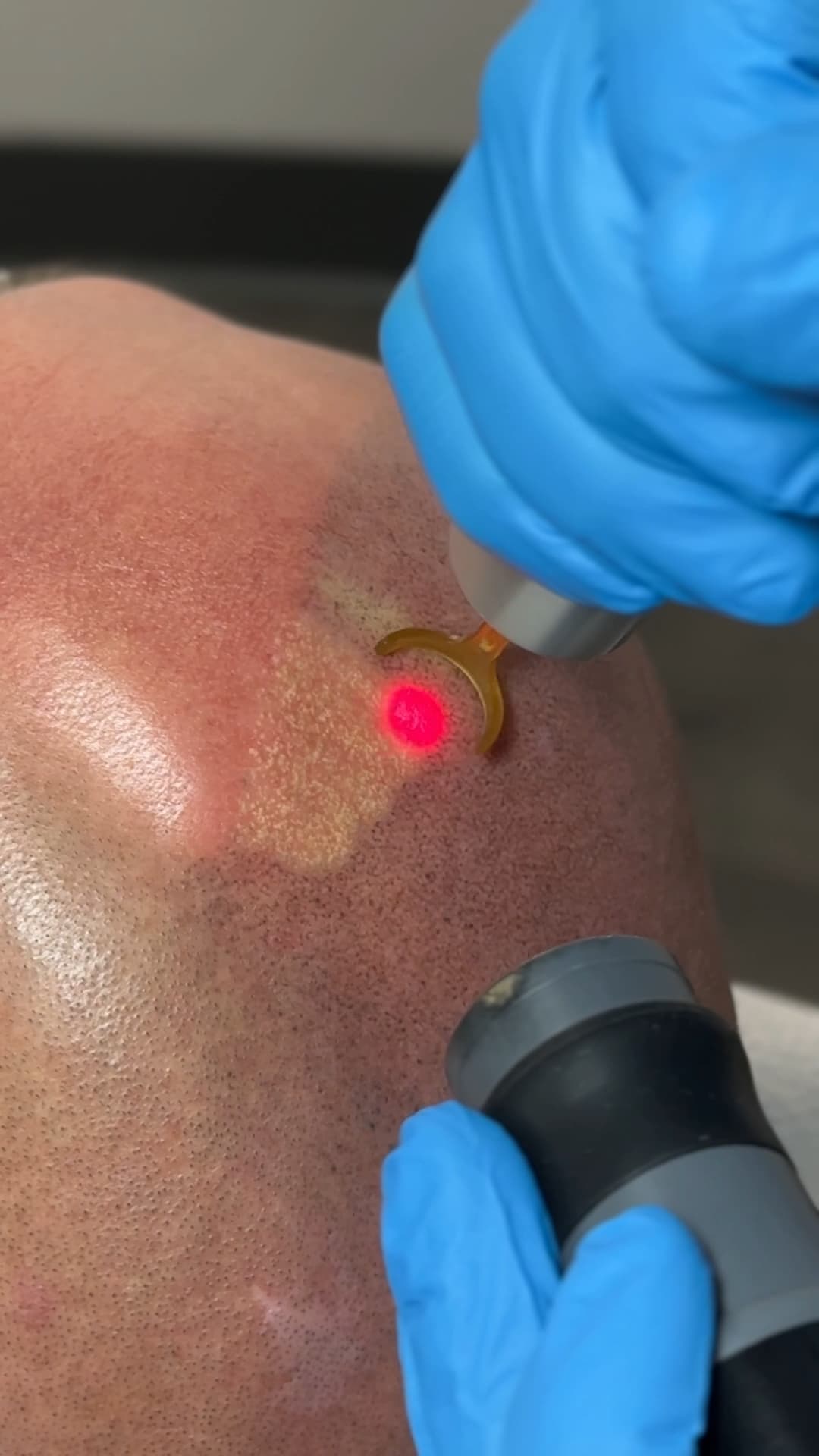
Almost everyone who books an SMP removal consultation asks some version of the same question before anything else: will the laser hurt the hair that is still there? It is a fair worry. Most people who got scalp micropigmentation in the first place were already dealing with thinning or loss, and the idea of aiming a laser at the scalp sounds like the opposite of protecting what is left.
The short answer is that the hair follicle is not what the laser is looking for. Understanding why takes about two minutes, and it also explains the part that does carry real risk.
What the laser is actually aiming at
SMP is a cosmetic tattoo. Each dot is a deposit of pigment placed in the skin to imitate the look of a shaved follicle, and laser removal treats it the way it treats any other tattoo: concentrated energy is absorbed by the pigment, the pigment fragments into particles small enough to move, and the lymphatic system clears those particles over the weeks that follow.
That absorption is selective. The energy is delivered in a pulse measured in picoseconds, a trillionth of a second, which is short enough to shatter a pigment particle mechanically rather than cook the tissue around it. Studio Kiku uses the Candela PicoWay for this reason. In the hands of a technician who has done the work before, the pigment breaks up, the skin stays intact, and the follicles around the treated dots are not the target of the pass.
Billy DeCola, the founder of Studio Kiku, is direct about why the device matters on a head. Speaking on The Faded Podcast, he says of the PicoWay: "It's best for darker skin tones, and it will remove the pigment without creating any damage, and that's what you want."
Why a close shave makes the session cleaner
Shaving the head is not mandatory before SMP removal, but a closely shaved scalp can make the treatment more efficient. Hair lying over the treatment area sits between the handpiece and the pigment underneath it, and the technician is working dot by dot across an area where the original placement is often uneven.
For clients with thinning hair rather than a fully shaved head, this gets discussed at the consultation rather than decided on the day. How much hair is present, where the pigment sits relative to it, and whether the goal is a full clear or a lightening for new work all change the plan.
The scalp is more sensitive than an arm
Comfort, not follicle damage, is the part most clients underestimate. The skin on the head is thinner than the skin on a forearm or a thigh, and the area around the ears is more tender again. Numbing cream, ice, and cold air are available through the session, and treatments are spaced a minimum of 8 weeks apart so the skin recovers fully and the body has time to process the pigment already fragmented.
Plan on taking it easy for a day or two afterward. Direct sun on a freshly treated scalp, a sauna, hot yoga, or a hard training session all work against the skin while it is settling.
How many sessions this takes depends entirely on how the original work was done. Light, shallow SMP can fade quickly. Deep, oversaturated pigment is some of the most stubborn material the studio treats, and warm undertones that an artist mixed in to stop the pigment healing grey can surface once the dark top layer lifts.
Where scalp damage actually comes from
Damage to a scalp during removal is real, and it does happen. It comes from the operator and the equipment, not from the process itself.
Billy has seen the results: "I've seen people with scar tissue on their head because they used the laser that shouldn't have been used on their skin tone, or it was just used improperly. The settings way too high."
That is the whole risk, stated plainly. A device that is wrong for the skin tone in front of it, or correct settings pushed past where they should be, is what marks a scalp. So the questions worth asking any studio are about experience with SMP specifically: how many scalps the technician has treated, what device is in the room, and whether there are before and after photographs of SMP work rather than body tattoos.
One more limit is worth stating. Removal clears pigment, and that is all it does. It does not restore hair, slow hair loss, or change the underlying reason the SMP was applied. If new SMP is the plan once the area is clear, the scalp needs a minimum of 3 to 6 months after the final laser session before fresh work goes over it.
Getting a read on your scalp
A consultation is the point where guessing stops. The pigment gets assessed for depth and saturation, the hair in the area gets taken into account, and you get told what a series of sessions can realistically do with what is on your head right now. There is no charge and no obligation to book treatment afterward. Book a free consultation in Vancouver, Langley, or Vaughan, or read more about how SMP removal works before you come in.
Thanks for reading.