
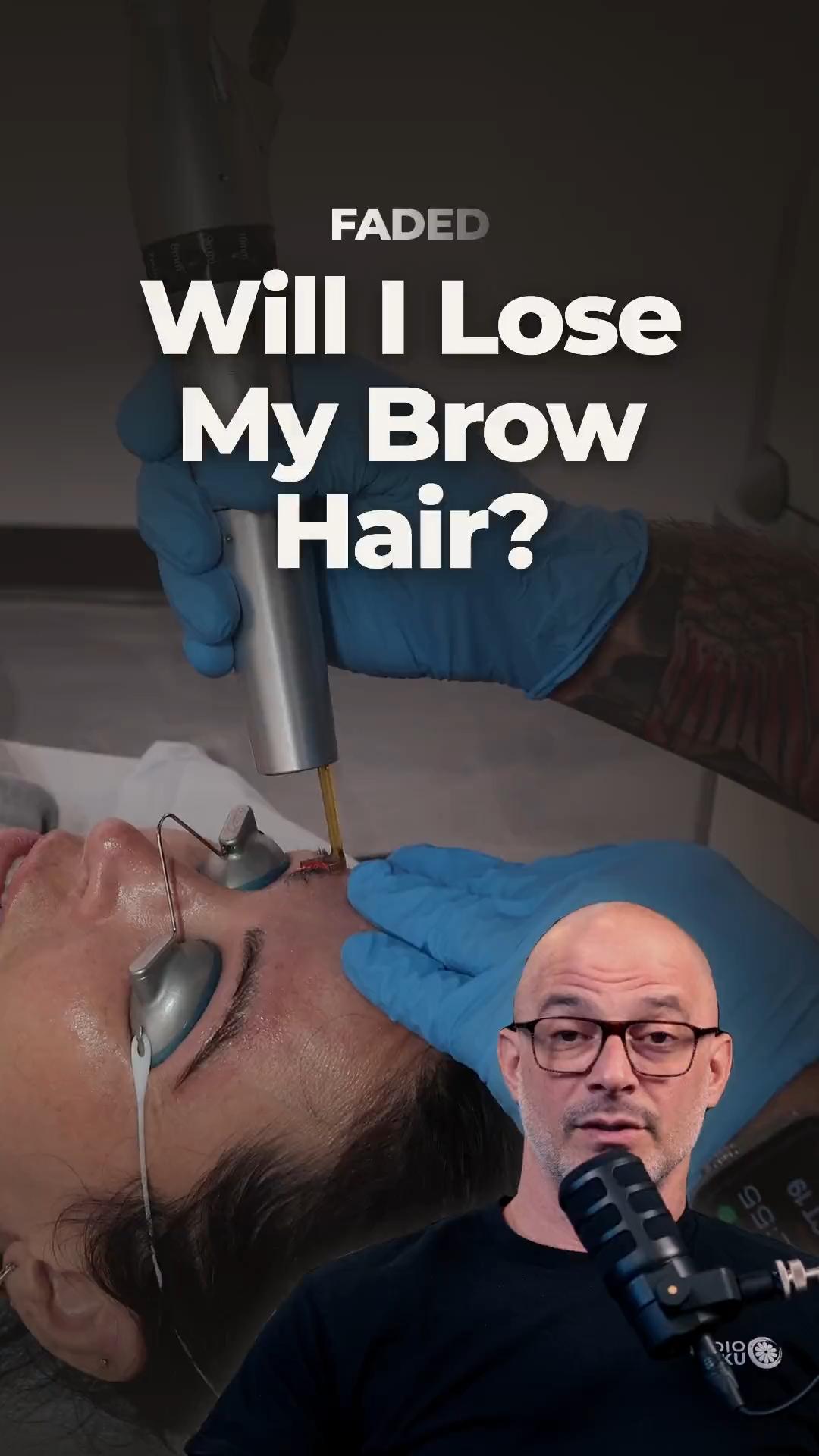
You finally decided the old microblading or powder brows have to go, and then you read one story online about someone's brow hair falling out after laser PMU removal. Now the question sitting in your head is simple: will the laser take your natural brows along with the pigment?
It is the first thing most brow clients ask at Studio Kiku, and it is a fair worry. The answer depends on two things you can check before you book: the laser the studio uses and the person holding it.
The two ways brow hair gets damaged
Billy DeCola, founder of Studio Kiku, breaks hair loss after brow removal into two separate problems. "Those are the two reasons why people experience hair loss," he explains on the FADED Podcast. "Either the hair follicles are damaged or the hair outside of the skin, the exterior hair is being damaged by the laser."
The first is the serious one. A follicle is the small structure under the skin that grows each hair, and if it is damaged, the hair it produced may not come back. The second is surface damage: hairs above the skin get singed, become brittle, and break off, which can look like hair loss even when the follicle underneath is untouched.
Both come from the same root cause, which is heat. A laser that delivers its energy slowly lets more heat build up in the skin around the pigment, and the follicles and hairs sitting in that skin pay for it.
Why the laser matters so much
"The number one reason why this is happening is because the wrong laser is being used," says Billy DeCola.
The key idea is pulse duration, which is simply how long each pulse of laser energy lasts. A shorter pulse breaks the pigment apart with less heat spreading into the surrounding tissue. A longer pulse transfers more heat, and more heat means a greater chance of harming the hair. Power matters too: a laser without enough peak power struggles to break the pigment up, so the brows need more sessions to clear.
Studio Kiku uses the PicoWay by Candela, a picosecond laser, for brow removal. "The Pico way does not damage the hair follicles," Billy says. "There are other lasers out there, not the Pico way, but other lasers that definitely do harm the hair follicles."
The word "pico" on its own does not settle the question. Plenty of machines borrow the name in their advertising, and a laser can carry the label without matching the pulse speed or power of the established platforms. If you are comparing studios, ask which laser they use by its full brand name.
Why technique counts as much as the machine
The right laser is only half of it. Billy's point is that a studio can own excellent equipment and still damage the hair if the person operating it does not know how to use it, much like owning a fast car does not make someone a good driver.
On brows, technique means reading the pigment and holding back where it counts. Most brow pigment carries a warm undertone of red, yellow, or both, and the dark pigment usually lifts first. A technician who chases every trace of colour in a single visit by turning the laser up is putting the skin and hair at risk. That is why complete brow removal at Studio Kiku is spread over 3 to 6 sessions on average, with sessions at least 8 weeks apart, rather than forced through in one or two.
Billy is direct about the trade-off. "Could we get it off in one session? Most likely we could. Is it safe? Will your skin or your hair follicles or your hairs be okay? Probably not."
Follicle damage can surface months later
The difficult part of brow hair damage is the timing. A follicle that has been overheated may not show any sign of it on the day of the session. The skin can look fine, the pigment can look lighter, and the problem only becomes clear months later, when the natural hairs that should be growing in simply are not.
That delay is the reason to choose carefully before the first session rather than after. Once a follicle is damaged, no later treatment at any studio can promise to bring that hair back. The safer path is a laser built for short pulses, a technician experienced with brows specifically, and a pace that treats your natural hair as something worth protecting.
It is also worth knowing that laser cannot always finish the job safely. If a stubborn yellow undertone does not respond after a few sessions, the team will tell you to stop rather than turn up the energy, and saline removal may be the better route for what is left. The PMU removal page explains how the two approaches fit together.
What to expect in the weeks after a brow session
Right after a session, the brows and the skin around them usually look flushed, and that redness can briefly hide what is underneath. The team judges progress once the skin has settled, not in the chair. A cold compress on the day of the session and the day after, and cool water when washing, help keep the area comfortable. The full routine is on the laser PMU aftercare page.
If your brows were tattooed recently, plan on waiting about three months before the first laser session so the pigment and skin have settled.
Bring your brow questions to a consultation
If you are weighing whether to remove your brows and want to see how your pigment and natural hair might respond, a consultation is free and there is no obligation to start. The team can look at the colour in your brows, explain what the PicoWay will and will not do to them, and talk through a pace that keeps your own hair in place. Book a free consultation in Vancouver, Langley, or Vaughan.
Thanks for reading.